
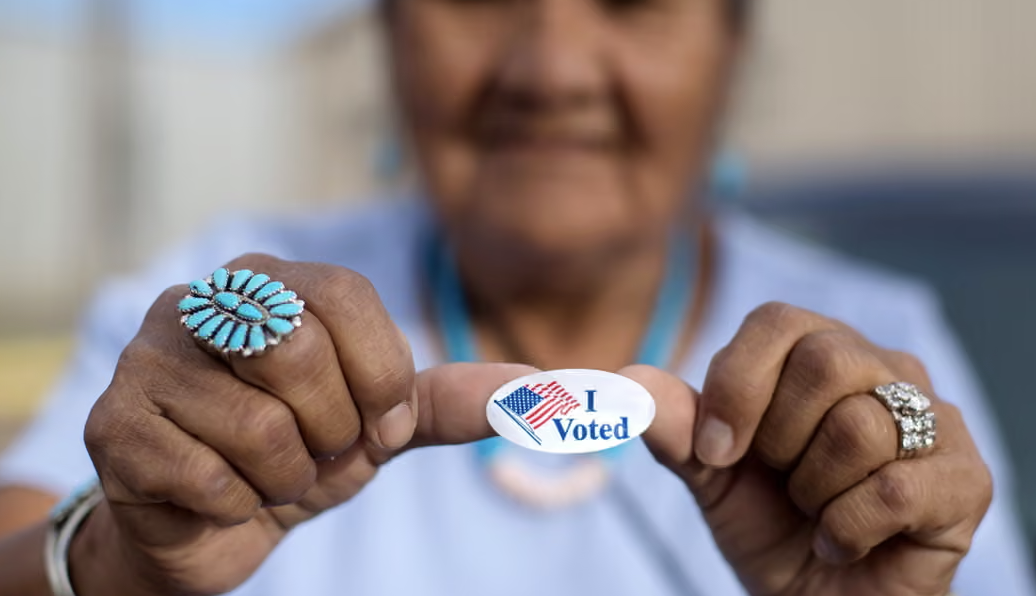
“Sometimes Native voters have to travel 20, 30, 40, 50, even up to 100 miles in order to access a ballot box,” said Jacqueline DeLeón, senior attorney at the Native American Rights Fund (NARF). “Native Americans are really structurally locked out of voting in many cases.”
With the November 3 midterm elections approaching, voting rights organizations are preparing for a range of challenges affecting Native American, Latino, Black and Asian American voters. These include restrictions on mail-in ballots, voter identification requirements, redistricting, limited access to polling places and concerns about immigration enforcement.
At a national news briefing hosted by American Community Media, representatives from four voting rights organizations discussed the legal and practical obstacles facing voters and their efforts to protect participation in the upcoming election.
For Native American voters, many of these problems are longstanding. DeLeón, who leads NARF's voting rights practice group, said that the distance between reservations and election facilities, combined with inadequate infrastructure and restrictive registration requirements, continues to prevent eligible voters from participating.
In some rural communities, homes do not have conventional street addresses, creating complications when residents attempt to register or verify their eligibility. Residential mail delivery is also unavailable in many reservation communities, requiring voters to travel to post offices, sometimes considerable distances away, to collect or return election materials.
Access to transportation presents another obstacle. Poor road conditions, limited vehicle ownership and the expense of traveling to election offices can make voting considerably more difficult for residents of remote reservations.
NARF documented these conditions through nine field hearings held across Indian Country. Its more recent report, Obstacles Persist, examines disparities in ballot rejection rates, distances to polling locations and other structural barriers using additional quantitative evidence.
DeLeón said the findings demonstrate that Native communities continue to receive unequal access to election services, including voter registration, early voting and Election Day polling places.
“Despite our requests or demands for on-reservation access, we often do not have equitable access in Native communities,” she said.
The organization supports the Native American Voting Rights Act, bipartisan federal legislation intended to address these disparities. Among its provisions are requirements for accessible registration and polling opportunities on reservations, greater acceptance of tribal identification and protections for voters whose homes lack conventional addresses.
DeLeón said the legislation would establish clearer obligations for election administrators rather than leaving access to the discretion of individual counties.
NARF is also pursuing changes through litigation and state legislation. The organization has challenged inadequate polling access and election systems that dilute Native voting strength.
One concern involves at-large elections, in which an entire county or school district votes for the same slate of representatives rather than electing candidates from smaller geographic districts.
In communities where Native Americans make up a substantial portion of the population but are outnumbered in the larger electorate, DeLeón said these systems can prevent Native candidates from winning office.
She described the Voting Rights Act as an important legal mechanism for challenging discriminatory electoral structures and expressed concern about recent Supreme Court decisions affecting the law's enforcement.
The organization is reviewing the consequences of those decisions while continuing to advocate for federal and state protections.
DeLeón also cited racial discrimination in communities bordering reservations as a continuing problem, arguing that unequal treatment and the allocation of election resources cannot always be separated.
For the November election, NARF plans to deploy approximately 300 poll watchers across rural Native communities. Observers will document problems at polling locations and report directly to the organization's attorneys.
The organization is preparing to seek legal remedies when necessary, including extensions of voting hours if polling places open late or equipment failures prevent residents from casting ballots.
DeLeón said election administrators in some Native communities have previously encountered problems ranging from malfunctioning voting equipment to insufficient staffing and delayed openings.
The challenges facing Native voters are part of a wider pattern of unequal access described by other speakers.
In Georgia, Monica Spencer, state director of VoteRiders and an ordained minister, said voter identification laws create financial and logistical obstacles for people who lack current government-issued identification.
VoteRiders provides free assistance obtaining identification and supporting documents, including birth certificates and transportation to government offices.
Spencer said approximately 34 million voting-age Americans lack updated identification, while an estimated 21 million eligible voters lack easy


