
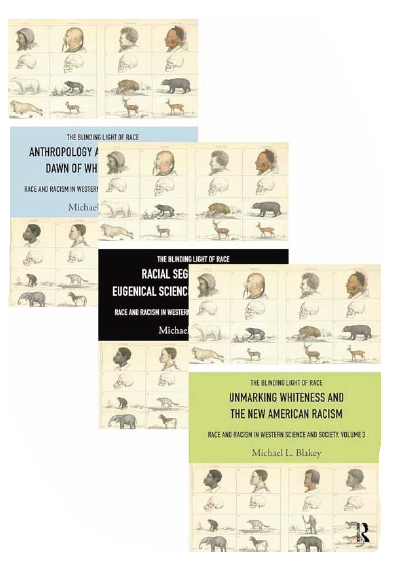
The Blinding Light of Race: Race and Racism in Western Science and Society is a major three-volume scholarly work by Michael L. Blakey, a prominent biological anthropologist and National Endowment for the Humanities Professor of Anthropology at the College of William & Mary. The project provides a comprehensive historical and scientific critique of how Western science, particularly anthropology, has been used to construct and justify white supremacy.
The work is divided into three volumes that track the evolution of racial ideology from its religious roots to modern scientific “neutrality”:
• Volume 1: Anthropology and Slavery at the Dawn of White Supremacy
Examines the transition from religious to “natural” justifications for inequality. Blakey argues that the concept of race emerged during the European Enlightenment to provide “moral cover” for the transatlantic slave trade.
• Volume 2: The Professionalization of Anthropology and the Global Color Line
Details how anthropology grew as a profession in the early 20th century, promoting a worldview of white superiority rooted in “nature” rather than law. It tracks this through the rise of eugenics and the subsequent global shift following the defeat of Nazi Germany.
• Volume 3: Unmarking Whiteness and the New American Racism
Addresses late 20th and 21st-century manifestations of white supremacy. Blakey critiques “performative” anti-racism—such as diversity programs—that he argues often serve to obscure ongoing material discrimination and “white fragility”.
Key Concepts
• The “Nature Politic”: Blakey's term for the broad set of assumptions where racism is embedded. He posits that science replaced religion as the authority used to externalize human responsibility for inequality by attributing it to “nature”.
• Scientific Racism: The work demonstrates how leading scholars used scientific methods to support biased, racist theoretical interpretations, such as polygeny (the idea that different races are separate species).
• Project as a case study. He contrasts the “public archaeology” models used by white institutions with the “descendant community” model that empowers Black voices to steward their own history.
Please inquire with your local library to ensure this recently published series is available.


