
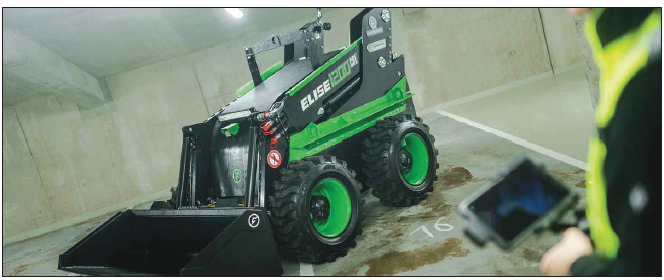
Look at the operator’s seat.
It is changing.
Sometimes it is still inside the machine. Sometimes it is a remote control station with live camera feeds from a tunnel. And sometimes, the machine appears as a digital twin in XR, helping service teams, technicians and partners understand, diagnose and support it without always standing next to the physical machine.
This is the shift FIRSTGREEN Industries is building.
Not only from diesel to electric.
From working machines to connected, intelligent platforms.
Electric power is where the change starts.
No local emissions. Low noise. Fewer operational fluids. Lower routine maintenance. More precise control.
These are already strong advantages in construction, demolition, agriculture, municipal work, indoor applications and underground environments.
But for FIRSTGREEN, electrification is not the final story.
It is the hardware base for something bigger: a machine that can be digitally controlled, remotely operated, connected to data, supported through diagnostics and prepared for smart assistance functions.
The machine is no longer just powered differently.
It can behave differently.
The machine becomes a data platform.
A modern working machine should not be a closed mechanical box.
It should know what is happening inside the system. It should support diagnostics. It should help operators set the right working mode. It should give service teams better information. It should be easier to configure, update, support and understand.
This is the logic behind FIRSTGREEN’s Optimization & Connectivity direction.
From fleet management and machine data to diagnostics, operating modes, software support and remote service logic, the goal is simple: keep the machine working, reduce downtime and make advanced technology easier to use in real operations.
Because the smartest machine is not the one with the most features.
It is the one that helps people work better.
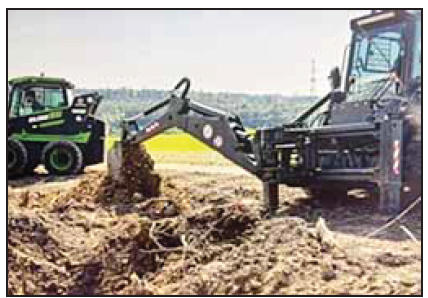
From the cabin to the control station.
A machine does not always need the operator sitting inside it.
With cameras, sensors and connection through Wi-Fi, LTE or 5G, a working machine can be operated from a remote station. The operator sees the job through live camera views, controls the machine through joysticks and stays away from dust, vibration, noise or hazardous areas.
This matters in underground sites, demolition, contaminated zones, rescue operations and confined environments.
At the Josef Underground Laboratory, this idea becomes very concrete.
The machine may be in the hazard zone.
The operator does not have to be.
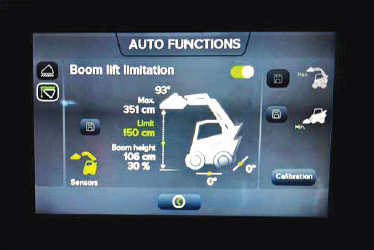
The next layer of machine control.
Remote control is only one step.
FIRSTGREEN is also working with the wider logic of Control, Autonomy & AI: smart control systems, sensor-based functions, machine assistance, teleoperation and future autonomous capabilities.
This includes practical functions that are already easy to understand from the operator’s point of view: movement control, speed profiles, sensor calibration, auto functions, boom lift limitation, machine diagnostics and more precise control of hydraulic and travel behavior.
These are not abstract buzzwords.
They are the difference between a machine that only reacts to the operator and a machine that actively helps the operator work more safely, more precisely and with fewer unnecessary steps.
XR, digital twin and service support
A smarter way to understand and support the machine.
The next innovation layer is not only inside the machine.
It is also around it.
With XR and digital twin tools, operators, technicians and partners can see the machine in a new way. They can explore components, understand functions, follow guided service procedures, support diagnostics and train without depending only on static manuals or direct access to the physical machine.
This is not about controlling the machine through a VR headset.
It is about making service, diagnostics, training and partner support faster, clearer and more visual.
For partners, this means faster onboarding.
For service teams, better support.
For customers, less uncertainty and more confidence in the technology.
Where GPS, diesel and direct presence reach their limits.
Underground is one of the clearest environments where this technology makes sense.
Space is limited. Visibility is difficult. Ventilation matters. Noise matters. GPS does not work. And putting people close to risk should never be the default option.
That is why underground robotics is not a side topic for FIRSTGREEN.
It is a proving ground.
Electric platforms, remote operation, teleoperation, sensors, machine vision and autonomous assistance can come together exactly where traditional machines and traditional workflows start to struggle.
This is where the future of working machines stops being theoretical.
It enters the tunnel.
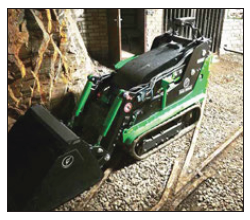
The machine starts adapting to the person.
FIRSTGREEN is developing a Follow Me function for an electric vehicle with a skid steer chassis.
The aim is to assemble, optimize and test a functional prototype capable of following a specific user without manual driving.
Imagine repetitive material handling, site preparation, movement through a controlled work zone or support tasks in environments where the operator should not constantly reposition the machine manually.
The operator stays in charge.
The machine starts to assist.
Follow Me is not about replacing people.
It is about removing unnecessary manual steps from the workday.
The project is carried out in cooperation with the Czech Technical University in Prague and is co-financed by the European Union.
The machine takes the risk. Not the operator.
In Belgium, Rockeat showed what remote operation means in practice.
The machine can work in a demanding area, while the operator stays at a safer distance and keeps control through a remote-control system with display support.
This is the practical value of cabinless, remotely operated electric machines.
They can enter places where the work needs to be done, without forcing the operator to stand directly in the risk zone.
Remote operation is not only a technology feature.
It is a safer way to work.
From machines to intelligent working platforms.
The future of working machines will not be defined only by what powers them.
It will be defined by how intelligently they support the people who use them.
At FIRSTGREEN Industries, that future is already moving from development to testing, from testing to machines, and from machines to real work.
In the coming months, we will introduce these innovations step by step in more detail, from teleoperation and XR-based service support to Follow Me, underground autonomy and other assistance technologies we are developing.
Electric was the beginning.
Machine intelligence is the next step.
FIRSTGREEN Industries Team
Think electric


