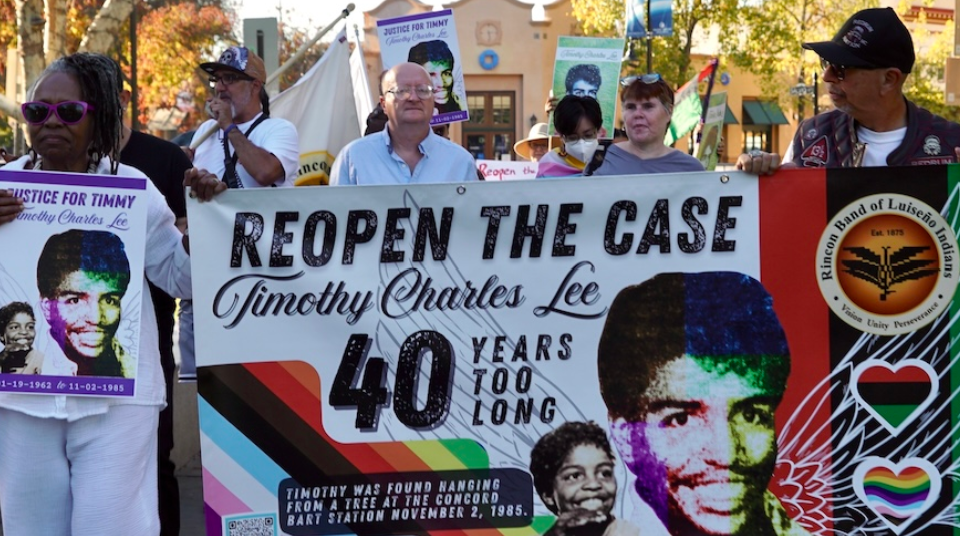
Image: Marchers carry a poster demanding justice for Timothy Charles Lee during the 2025 Justice for Timothy march in Concord, Calif. (Credit Maria Judice)
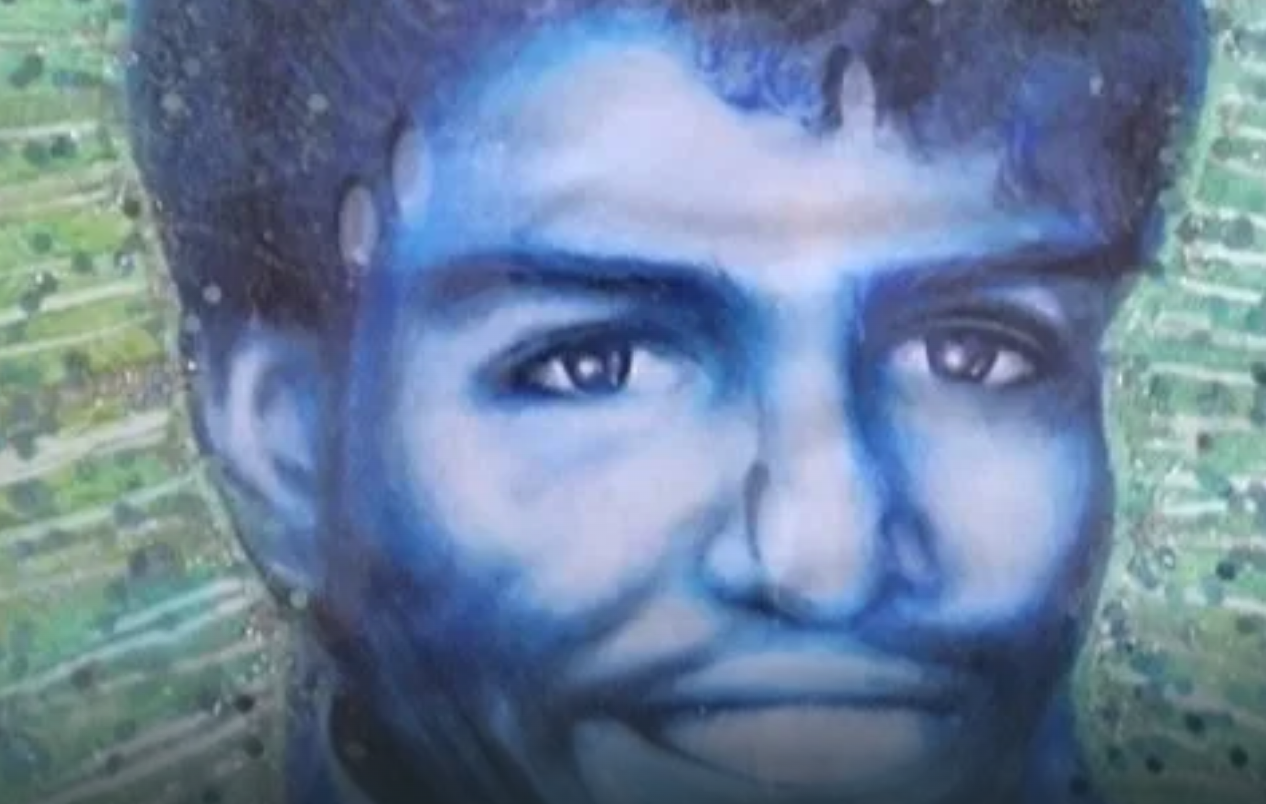
If Timothy Charles Lee were alive today, he’d likely be a 64 year old world renowned fashion designer standing tall in his identity and truth as a Native American member of the Rincon Band of Luiseño Indians, Black,Gay man. Instead, Lee lays at rest in the cemetery on a reservation in ValleyCenter, Calif, north of San Diego. Lee’s family, however, has not been able torest for the past 41 years, over what they say are suspicious circumstances ofhis death. Lee’s death was quickly ruled a suicide, a finding that Lee’s familyclaims simply doesn’t add up.
Family say that on Nov. 2, 1985 Lee was out celebrating life, as his future looked bright. He was a fashion design student at theAcademy of Art in San Francisco on track to study in Milan, Italy, where hehoped to bring his fashion design skills to the next level. Lee took the Bay Area Rapid Transit that fateful night, dozed off and missed his stop. He wokeup at Concord BART station, where he reportedly called for someone to come andpick him up. Lee, however, never got picked up. Later that night, he was found hanging from a fig tree with a noose around his neck, and was pronounced dead.
Frank Sterling, Lee’s first cousin, was 12-years old when Lee died.
“I knew something had happened to my cousin, but I feel likemy parents kept the details from me,” Sterling says.
Decades later, Sterling’s colleague at KPFA Radio in Berkley, Calif. did a story about the history of lynching that ended with mention of a well-dressed man found hanging from a tree outside of Concord BARTStation that sounded eerily familiar.
“I realized he was talking about my cousin. I started askingmy dad about what had happened and I started finding the FBI file online,”Sterling says. “I heard from an eye-witness that there were a group of youngmen surrounding Timmy and a uniformed officer close by.”
If those accounts are true and the young men were similar inage to Lee, who was 23 at the time, Sterling estimates that they could be intheir 60s.
“They could be living here in one of the houses in thissurrounding area,” Sterling says, while standing in front of the tree atConcord BART, where Lee was last alive. “If I can get some living people heldaccountable, that’s my ultimate goal. If not, I want to keep Timmy’s name aliveand remember that his story is a part of Concord history.”
Sterling says that even though it’s been 41 years since hiscousin died, he is just getting started in the fight for justice. For the pastfive years, Sterling has organized an annual ‘Justice for Timothy” walk outsideof the Concord BART station for the past five years and this year added on a“Living Timmy’s Dream” fashion show event in Walnut Creek, Calif. as afundraiser for the Rainbow Community Center, an organization that supportsLGBTQ+ youth and young adults in Concord, blocks away from where Lee’s lifeended.
While Lee’s death precedes the movement to increase exposureof Missing & Murdered Indigenous People, Sterling considers Lee’s death tobe a part of MMIP.
“Back in 1985 when this happened, I don’t know if they’dcoined the term MMIP, but I definitely consider Timmy to be a murderedindigenous person,” Sterling says.
Although Lee’s case was closed and ruled a suicide, Sterling and other members of the Justice for Timothy Charles Lee group say they’d verymuch like to see it reopened and investigated as an MMIP case. So far, Sterling hasn’t succeeded in getting the full support of the tribe but he hopes one daythat could change. Sterling notes that most of Lee’s immediate family members including his siblings and mother have passed and he carries the feeling ofresponsibility to fight for justice on his late cousin’s behalf and doeverything in his power to make sure his name lives on.
“Timmy was a member of the Rincon Band of Laceno Indians. He’s buried right now in their cemetery, along with my aunt Vicky, his sisterTammy, and his older brother Tommy,” Sterling says. “To me, he’s my cousin whodied too soon, but I very much think of him as an MMIP and I’d love the fullbacking of our tribe.”
Maria Judice, a documentarian, is working on a film projectaimed at keeping the life, legacy and fight for justice for Timothy Charles Leealive. At the 2025 walk for justice, Judice offered libation near an ofrendaset up in Lee’s honor.
“We’re going to remind (Timmy) that we are still out here working hard for you,” Judice said while pouring out water in front of the treewhere Lee’s life ended. “We’re looking for those who took your life. We’relooking for all the people who disregarded your murder as nothing more than asuicide. We’re loving you as our brother right now, and we’re all here foryou.”
Judice describes her approach to art and filmmaking as rooted in the African diaspora.
“We don’t believe time is linear. We believe time is acontinuum,” Judice says. “When I found out about this, I was around 23 yearsold. There’s a sense of what happens in the past that affects our present andalso dictates our future.”
Judice says her documentary project examines what freedomreally is and who it’s for, what is considered public space and publictransport, who can safely access those things.
“(It also discusses) what is considered a rest or a nap?”Judice says, referencing the fact that Lee fell asleep and missed his intended BART stop on the last night of his life. “Not all of us are afforded thosebasic rights.”
23 year old Zach Sexton is helping Judice with thedocumentary about Timothy Lee’s life. Sexton says it’s sobering to be the same age that Lee was when he died.
“In the Bay Area we feel that we’re safe, we feel that we’reseparate from this history of racism, and we know that’s not true,” Sexton says.
Nevertheless, four decades later, Sexton says he’s honored to continue doing the work to remember the late Timothy Charles Lee and fightfor justice on his behalf.
“And when we see Timothy Charles Lee, we understand thatthese separate identities (of Native, Black and Gay) are not separate, and each one has its own legacy of harm that we have to, you know, face head-on.”