

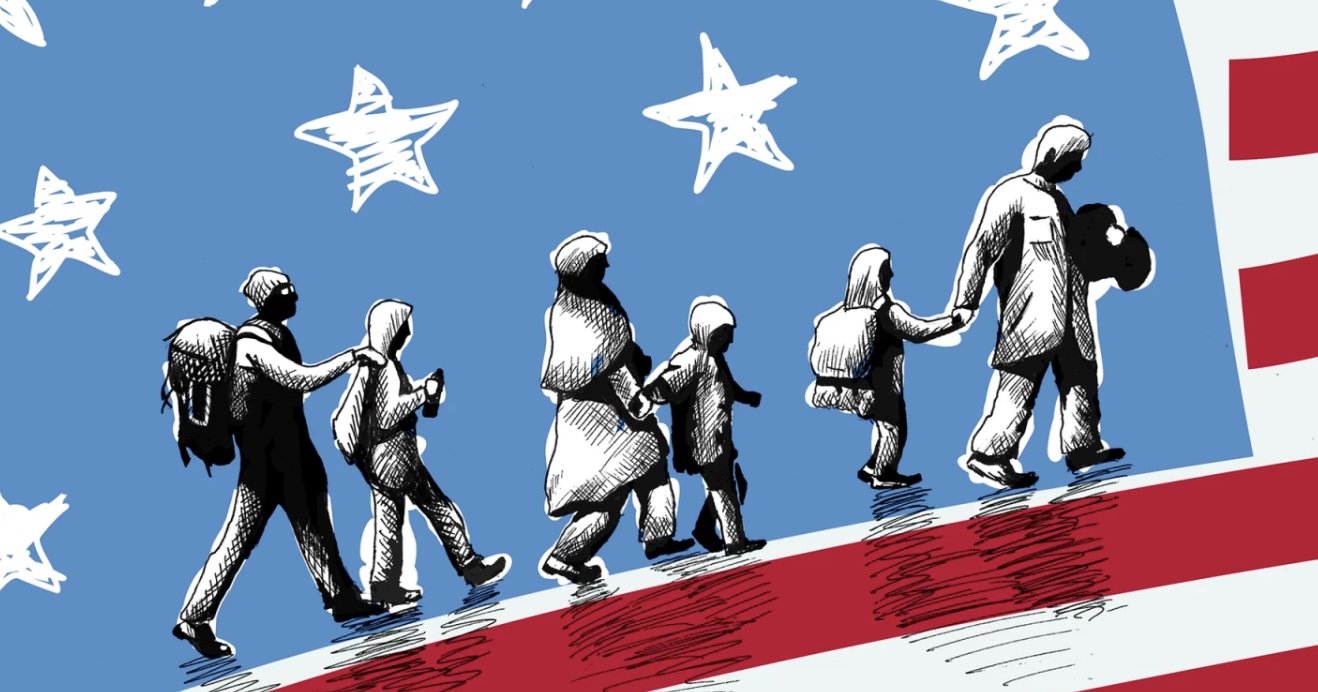
“The fear is bigger than the rule,” Xiao Wang said.
Wang, co-founder and chief executive of Boundless Immigration, was describing the reach of a new federal public charge rule that takes effect Sept. 18. The regulation gives immigration officers broader discretion to decide whether certain applicants for permanent residence are likely to depend on government assistance. Its formal reach is limited to particular immigration cases, he told reporters during an Aug. 7 American Community Media briefing. Its practical effect may extend much further, as families withdraw from health and nutrition programs that their children are legally entitled to use.
The rule revives a longstanding and contested part of federal immigration law. Since 1882, the government has had authority to deny admission or permanent residence to a person deemed likely to become a “public charge.” For much of the period from 1999 through 2019, the term was interpreted narrowly. Officials generally looked for primary dependence on cash assistance, including Supplemental Security Income and Temporary Assistance for Needy Families, or government-funded long-term institutional care.
The first Trump administration expanded that standard in 2019 to consider programs such as Medicaid, the Supplemental Nutrition Assistance Program and housing assistance. The policy was challenged in court and later replaced by a narrower 2022 regulation. The Department of Homeland Security finalized its latest change in July, rescinding the 2022 rule and restoring a broader review of an applicant’s circumstances.
Beginning Sept. 18, officers will weigh factors that include age, health, family status, finances, assets, education and skills. The government has also removed the 2019 rule’s numerical threshold, which focused on receipt of specified benefits for more than 12 months in a 36-month period. Wang said the absence of a similarly clear measure will make cases harder to prepare and decisions less predictable.
“We’re going from a world where there’s specific dollar amounts that you need to make,” Wang said, to one in which an officer can examine an applicant’s “whole background,” including schooling, age and medical conditions.
The added discretion is likely to produce longer applications and processing times, he said. During the earlier expansion of public charge, one case handled by Boundless grew from what would ordinarily have been an application of a few dozen pages to roughly 900 pages because of the supporting evidence required.
The new rule applies principally to people seeking green cards from within the United States through adjustment of status and to people abroad applying for admission as permanent residents. Many are relatives of U.S. citizens or lawful permanent residents. The change may also affect H-1B visa holders when they seek permanent residence through an employer or family member, Wang said, although it does not alter the requirements for the H-1B visa itself.
Applications for adjustment of status filed before Sept. 18 will remain subject to the 2022 standard, according to U.S. Citizenship and Immigration Services. The rule is not retroactive to previously approved green cards. Wang advised people who are eligible and ready to file before the effective date to do so, while cautioning that each case requires individual legal guidance.
Several groups remain exempt under federal law. They include refugees and asylees seeking adjustment of status, certain survivors of trafficking or other crimes, Special Immigrant Juveniles and some applicants protected under the Violence Against Women Act. Public charge is not part of the naturalization test for a green card holder applying for U.S. citizenship.
Those distinctions can be difficult to communicate in households where family members hold different immigration statuses. A U.S. citizen child’s use of Medicaid or food assistance is generally not treated as a benefit received by a parent applying for a green card. Many immigrants are themselves ineligible for federal means-tested programs during earlier stages of the immigration process. Yet families often stop benefits for eligible children because they fear any contact with government agencies could jeopardize a parent’s status.
Wang cited Urban Institute research from the previous expansion of public charge, when one in five adults in immigrant families reported avoiding a public benefit because of immigration concerns. Among adults in low-income immigrant families, the figure was three in 10.
The effect is already visible in children’s health coverage, according to Joan Alker, executive director of Georgetown University’s Center for Children and Families and a research professor at the McCourt School of Public Policy. One in four children in the United States lives in a family that includes at least one immigrant parent, she said. Between 40 and 50 percent of U.S. children receive health coverage through Medicaid or the Children’s Health Insurance Program, known as CHIP.
By June, 2.3 million fewer children were enrolled in Medicaid and CHIP than in January 2025, according to the center’s enrollment tracker. The data do not show how many of those children are now uninsured or how many live in mixed-status households. Alker said the scale and timing of the decline nevertheless raise concern that immigration enforcement and fear are keeping eligible families from enrolling.
The drop began before the new public charge rule takes effect. Alker pointed to several pressures on families, including an aggressive deportation campaign and the Department of Health and Human Services’ decision to share certain Medicaid information with immigration authorities, a policy that has faced litigation. Some states have adopted additional reporting requirements. She cited Indiana as the clearest example.
“Parents are scared to enroll their children in Medicaid and CHIP,” Alker said. Pediatricians and other providers have also reported fewer families coming to clinics because of concerns about immigration enforcement, she added.
Enrollment losses do not establish on their own that every child became uninsured. Some may have obtained private coverage. Past trends, however, show that when Medicaid enrollment falls, the share of uninsured children rises. During the first Trump administration, before the pandemic, Medicaid and CHIP enrollment among children fell by about 1 million, Alker said. The decline during the current administration has already exceeded that figure.
The consequences reach beyond whether a family can schedule a routine appointment. Uninsured children are less likely to receive primary and preventive care. A manageable condition such as asthma can become an emergency when a child cannot see a doctor or obtain medication. Emergency rooms must evaluate and stabilize patients regardless of insurance, but families may still face substantial bills. A broken bone, asthma attack or set of stitches can therefore expose a household to medical debt.
Research has linked childhood Medicaid coverage with better health, higher high school graduation rates and higher earnings in adulthood, Alker said. “It’s hard to think of a worse government policy” than forcing parents to weigh medical care for a child against fears about immigration consequences, she said.
Eligibility continues to vary by state. Federal law generally imposes a five-year waiting period on many lawfully present immigrants seeking Medicaid. About three dozen states have elected to cover lawfully residing children or pregnant people without that wait, Alker said. In those states, some children and pregnant people may remain eligible despite federal restrictions enacted in the 2025 budget law. Families should verify the rules where they live rather than assume that a federal change has ended coverage.
State enrollment data show broad losses, although detailed demographic and county-level information is not yet available. California has recorded a large decline in the number of children enrolled in Medi-Cal, the state’s Medicaid program, though its percentage decline is not among the highest. Indiana, Arizona and Alaska have had the largest proportional drops, Alker said. Census data expected this fall may show how many children became uninsured in 2025 and which groups were most affected. During the first Trump administration, the uninsured rate rose sharply among Latino children.
Food assistance is undergoing a parallel contraction. Dr. Giridhar Mallya, a public health physician and senior policy officer at the Robert Wood Johnson Foundation, said SNAP helps roughly 37 million people buy groceries. Close to four in 10 participants are children. The program also serves older adults, people with disabilities and workers whose wages do not cover basic expenses. The average monthly benefit is about $350 per household, he said.
U.S. citizens may qualify for SNAP based on income and other program rules. Green card holders generally face a five-year waiting period, with exceptions. Undocumented immigrants are not eligible and have never been eligible for the program. In mixed-status households, eligible U.S. citizen children can receive assistance even when their parents cannot.
During the first Trump administration’s public charge expansion, more than 700,000 children in mixed-status families lost SNAP over two years, Mallya said. He estimated that the policy contributed to a loss of food assistance for nearly 2 million people overall.
The new public charge rule arrives amid separate reductions imposed by the 2025 federal budget law. That law expanded work requirements to additional adults, including some parents of teenagers. It transferred substantial benefit and administrative costs from the federal government to states and removed eligibility from some lawfully present immigrants, including certain refugees, asylees and trafficking survivors. The changes are projected to reduce federal SNAP spending by nearly $200 billion over a decade, Mallya said.
At the time of the briefing, national and state data analyzed by the Center on Budget and Policy Priorities showed SNAP participation had fallen by more than 4.5 million people since the law’s enactment, including an estimated 1.5 million children. Updated national estimates released later in August placed the overall decline at roughly 5 million people through May. The contraction has occurred while unemployment remained relatively stable and food costs stayed high, indicating that the drop cannot be explained simply by an improving economy.
In Arizona’s 3rd Congressional District, which includes part of Phoenix, the share of households receiving SNAP fell from nearly 28 percent to 22 percent in six months, Mallya said. That meant roughly one in five households receiving the benefit in June 2025 no longer had it by December. Additional losses have occurred since then.
Food banks and school meals cannot replace the lost benefits. “Food banks are doing heroic work all across the country, but they can nowhere near fill the gap,” Mallya said. School lunch programs provide essential meals during the school day, but they do not feed an entire household or cover evenings, weekends and school breaks.
The programs are also administratively connected. A child in a household approved for SNAP may automatically qualify for free or reduced-price school meals. Losing SNAP does not necessarily make the child ineligible for a school meal program, but it can end automatic certification and require the family to submit another application with income documentation. For families already uncertain about immigration rules or government data sharing, another layer of paperwork can become a practical barrier.
The health effects of food insecurity can begin quickly. Mallya said hunger impairs a child’s attention, emotional regulation and ability to participate in school. It can also affect the immune, digestive and cardiovascular systems. Even shorter periods without adequate food may contribute to health problems that persist later in life.
Some of the SNAP reductions could be reversed by Congress. Anti-hunger and health groups have asked lawmakers working on the farm bill to restore funding and postpone the date when states must begin paying a portion of food benefit costs. Mallya said advocates are seeking a delay of at least two years.
For families making immediate decisions, all three speakers returned to the need for advice from people they already trust. Alker urged parents to contact pediatricians, school nurses, community health workers and health centers. Some pediatricians are using telehealth when fear prevents families from visiting in person. Wang recommended consulting a licensed immigration attorney or an accredited nonprofit representative and warned that periods of uncertainty can attract people offering unqualified or fraudulent legal help.
Lawsuits challenging the public charge rule are expected, Wang said, but he cautioned against assuming a nationwide injunction will stop it before Sept. 18. Courts have become less willing to issue broad injunctions, and the administration has had more success designing policies to withstand initial legal challenges, he said.
Even if the rule remains in place, much will depend on how individual officers apply it and what additional training and guidance USCIS provides. Applicants with similar circumstances may receive different decisions in different offices, Wang said. That uncertainty is part of the policy’s force. Families do not need to lose an immigration case for the rule to alter their behavior. They need only to believe that taking a child to a clinic or accepting help with groceries might be used against them.
Wang placed that instability within a larger failure of Congress to enact comprehensive immigration legislation. In the absence of durable lawmaking, major policy changes continue to come through the executive branch and can reverse direction with each administration. For immigrant families deciding whether to seek medical care or food assistance now, that political cycle is not abstract. It shapes choices made at the doctor’s office, the grocery store and the kitchen table long before an immigration officer opens a file.


