
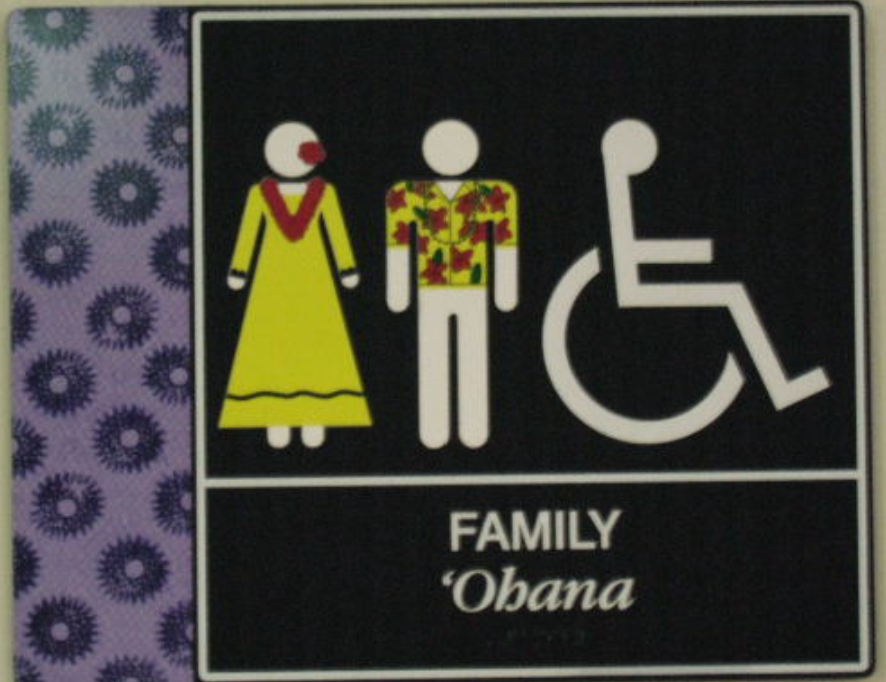
Photo: Sign at the washroom in Honolulu Airport, by (WT-shared) ぐら(gura), 2007, Wikimedia
Historical Context and Colonial Legacies
Colonial powers often imposed a single administrative language (e.g., English, French, Portuguese) to consolidate control, marginalize indigenous languages, and standardize governance. Postcolonial states inherited these linguistic hierarchies, where the colonial language became the dominant medium of power, education, and legal discourse. This created systemic disadvantages for speakers of indigenous or local languages, reinforcing cultural erasure and identity suppression.
Official bilingualism can decolonize through 1) recognition, 2) access to power and education, 3) reclaiming identity and knowledge systems, and 4) challenging bi-ethnocentric policies.
Recognition of Indigenous Languages
By making an indigenous or local language an official language, the state acknowledges its legitimacy and equal status, countering centuries of devaluation. This can restore cultural pride and validate community histories.
Access to Power and Education
Official bilingualism can ensure that governance, legal systems, and education are accessible in both the colonial and local languages, reducing linguistic barriers and enabling participation in public life.
Reclaiming Identity and Knowledge Systems
Language is central to identity and worldview. Recognizing and using indigenous languages in education and public discourse can decolonize identity by reconnecting people to their cultural knowledge systems.
Challenging Bi-Ethnocentric Policies
In some cases, official bilingualism has been criticized as “bi-ethnocentric” if it only recognizes two dominant languages and excludes others. A decolonial approach would expand this to include multiple languages and sign languages, reflecting the multilingual realities of many societies.
Challenges and Considerations
Resource Allocation: Implementing bilingualism requires investment in translation, teacher training, and infrastructure.
Political Will: Sustained commitment is needed to avoid symbolic gestures without structural change.
Avoiding Compartmentalization: Policies must integrate multiple languages into all spheres of life, not just ceremonial or educational settings.
Inclusivity: True decolonization demands recognizing not just two languages, but the full linguistic diversity of the population.
Examples
Canada: Official bilingualism (English and French) was partly a response to Quebec’s linguistic rights, but it also opened space for Indigenous languages in education and governance, though implementation varies since Canada’s 2012 adoption of its Official Indigenous Languages Act.

United States: Hawaiʻi’s 1978 Constitution recognized Hawaiian language as co-official with English as well as established the State’s responsibility to revitalize Hawaiian, and in 2022 enough speakers of Hawaiian in Maui County enabled its voters to make its government bilingual. The 1990 Native American Languages Act began to finance indigenous language revitalization, and in 2014 Alaska made all of its 20 indigenous language co-official with English; South Dakota did the same in 2019 with all three dialects of Sioux.

Africa & Latin America: Some postcolonial states have adopted bilingual education policies to balance colonial languages with indigenous languages, aiming to decolonize identity and knowledge production. 60% of the 54 sovereign African countries give official status to at least one indigenous language. South Africa recognizes eleven indigenous languages as co-official with English. 65% of Latin America’s nations provide constitutional or official recognition of at least one of their indigenous languages. Paraguay’s 1992 recognition of Guarani as co-official with Spanish has resulted in today’s 90% fluency rate of its indigenous language. All 68 indigenous languages of Mexico have enjoyed official status since 2003, and now some states in Mexico now teach all subjects of primary education in as many as four indigenous languages.
In summary, official bilingualism can be a decolonizing force when it is not merely a technical policy but a political commitment to linguistic equality, cultural recognition, and inclusive governance. It must be paired with broader decolonial education and policy reforms to dismantle the colonial linguistic order and empower all communities.


.jpg)