
53rd Annual Cal State University Long Beach Pow Wow
“On Sacred Ground, We Dance in Spirit—We Are Not Alone," Cal State Long Beach Pow Wow
Long Beach, CA — It is to step into a circle with no beginning and no end a living ring of memory, responsibility, prayer, and people. Here, movement turns into medicine. Songs rise like breath from the earth, carrying languages older than the concrete and grass beneath your feet. Each step you take is never solitary; the ancestors walk beside you; their presence felt in the drum’s deep pulse, the sway of regalia, and the sudden hush when the ocean fog wraps everything gray.
For many Native people, the pow wow is not an event on a calendar. It is a way of being. Dancers move not just for themselves, but for those who came before, for those whose feet can no longer touch the ground, and for the children yet to come. Regalia is not worn for show it is carried with purpose. Every bead, every feather, every shell holds story, spirit, and lineage. It is survival made visible. It is love and grief stitched into motion.
This is how the 53rd Annual California State University, Long Beach Pow Wow at Puvungna began under clear skies with a steady coastal breeze that felt like the land itself remembering.
Puvungna is sacred ground. Long before the Walter Pyramid stood in the distance or the intramural fields hosted grand entries, this was a village and ceremonial place for the Gabrielino/Tongva (San Gabrielino) and Acjachemen/Juaneño peoples. It holds emergence stories, creation teachings, and the spiritual power of thousands of years. To dance here is to move upon soil that still carries the prayers of the first stewards on ground listed on the National Register of Historic Places and held in reverence as a place where the Creator spoke and the people gathered.
From early morning, the campus filled with quiet intention. Cars lined the streets. Students and visitors walked toward the circle with purpose. This student-run gathering one of the largest of its kind in the nation endures because generations chose to carry it forward, even through times when songs were silenced and dancing was forbidden.
By midday, the grounds came alive. Vendors stretched in colorful rows, tables heavy with beadwork, jewelry, regalia, art, and clothing. The warm scent of frybread, barbecue, Navajo tacos, and stew drifted on the breeze familiar, grounding, pulling people not just to eat but to remember who they are and where they come from. Vendors are keepers of the circle too, sustaining knowledge, skill, and medicine through hands that connect past to present.
At the center stood the drum, the heartbeat, steady and unrelenting. Singers held the songs that traveled outward, touching every dancer, every listener, every spirit. Through that sound, the people were bound across time and distance.
Nearby, the Golden State Gourd Society stood with quiet dignity, opening the day with gourd dancing, honoring veterans, and upholding protocol. Their presence reminded everyone: this circle is not casual. It is protected. It is respected. It is carried out with discipline.
Flags of many Nations formed a respectful perimeter around the arena Cheyenne Arapaho, Muscogee (Creek) Nation of Oklahoma, Oglala Sioux, Oneida, Kiowa, Cherokee, Diné/Navajo, Desert Band of Chippewa, and others alongside the American flag, veterans’ staffs, and POW/MIA remembrance. This year marked a powerful first on this sacred ground: the San Gabrielino (Gabrielino/Tongva) flag made its debut in the circle and was staffed by tribal members during the pow wow. On the very land of Puvungna their ancestral home, this inclusion felt like a quiet homecoming, a deeper acknowledgment of the original caretakers whose presence has always lived here, even when overlooked.
As the day moved into evening, something unplanned and profound unfolded. A cool ocean fog rolled in slowly, silently, wrapping the arena in soft gray. It softened the edges of the Walter Pyramid until it became a distant shadow. Moisture settled on skin, on regalia, on the grass. The outside world cars, planes, and city noise faded away. Aircraft lights above turned into faint pinpricks in the mist. Visibility narrowed until only the circle remained.
You could not fully capture this moment with a camera or words. You had to stand inside it. You had to feel the damp air on your face, hear the drum vibrating through the fog, and sense how the ancestors seemed closer than ever dancing just beyond the veil.
For some, the gathering is a brief walk-through vendors, a few songs, a moment of beauty. For others, it is life itself. Identity. Continuity.
Within the circle move fathers and singers, mothers and supporters, daughters and sons, sisters and cousins all connected not by sameness, but by belonging. People travel from across the country and from many Nations to reconnect, to remember, to continue.
We come from different teachings, different languages, different paths. Yet here, in this circle, we are one people. One nation.
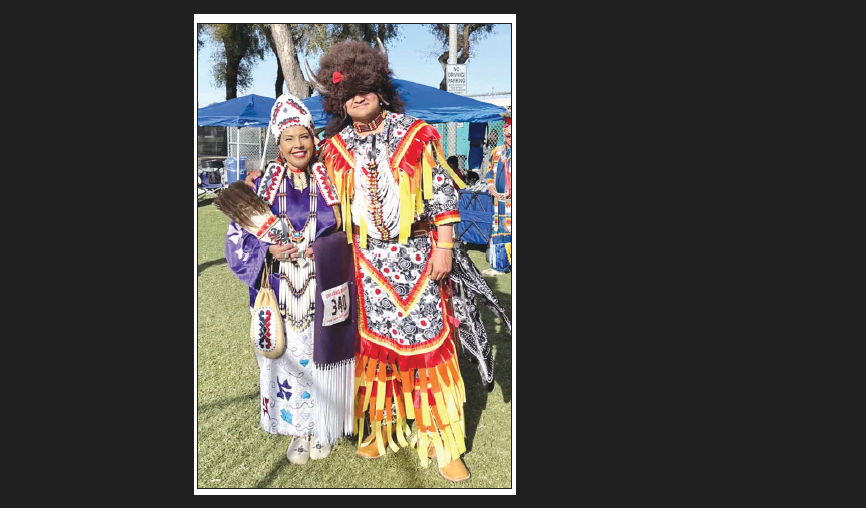
Among those walking these grounds are Venture O’Neal (Iron Buffalo Cloud) and Melissa Gonzales of Pasadena both dancers, both carrying more than their own stories.
Both were raised in Indigenous families shaped by the relocation era of the 1960s what many call the Sixties Scoop when families were displaced, roots disrupted, and identity often forced into unfamiliar spaces. Growing up as Urban Natives in Los Angeles meant living between worlds: feeling the deep pull of tradition while navigating environments that did not always see or reflect who they were. That upbringing leaves questions. It leaves distance. It leaves a quiet longing to understand where you truly belong.
Healing from that is not simple. It is not perfect. It is ongoing. But it is happening and it is happening in motion.
For Melissa, that healing travels with her each time she steps into the arena wearing her mother’s regalia. It is not something she simply puts on; it is something she carries. Every stitch holds memory. Every movement holds love, grief, and teaching. It is a visible continuation of life that shaped her.
“When I dance in her regalia, I feel her with me,” Melissa shares, her voice steady yet heavy with feeling. “It’s not about filling her place it’s about honoring what she gave me. I carry that every time I step into the circle.”
For Venture, the calling has taken him deeper back to the land in Montana, where he now lives on the reservation, stepping fully into a life grounded in tradition, community, and responsibility. There, he is not only dancing; he is contributing, mentoring, and building relationships within the community he now calls home. At the same time, he carries the work outward through his podcasting, using modern tools to share Indigenous voices, experiences, and truths with a wider world bridging the traditional and the contemporary.
“I was called back to this way of life,” Venture reflects. “And now it’s my responsibility to live it and to share it.”
His journey does not stop in one place. He plans to travel to reservations across the country, dancing, connecting, and offering mentorship and leadership to youth so that what was once at risk of being lost continues forward with strength.
Melissa, in her own path, builds that same continuity through her nonprofit creating spaces for engagement, education, and cultural connection. She hosts workshops, teaches classes, and opens doors for others to learn, share, and grow.
Together, their paths reflect something larger than themselves: a generation finding its way back. Not perfectly. Not without challenge. But with fierce intention and purpose.
Because for those raised between worlds, there comes a moment when the circle calls you home. And when it does you answer.
Here on Puvungna, generations layer into one space: elders holding knowledge, adults guiding and protecting, youth learning, children beginning to feel their place. This is why the pow wow exists not as spectacle, but as survival. As resistance. As life renewed.
There was a time when these songs were forbidden, when dancing was outlawed, when gathering like this carried real danger. What stands today is not imitation. It is the living refusal to disappear. It is culture in motion on the very land where it first took root.
As the final songs rose through the fog-covered arena and the circle gently came to rest, what remained was deeper than sound. It was understanding. It was belonging. It was the quiet knowledge that once you step into this circle even for a moment you carry it with you forever.
And for those who live it, who were raised in it, who return to it year after year
The circle never closes.
It is carried forward.


