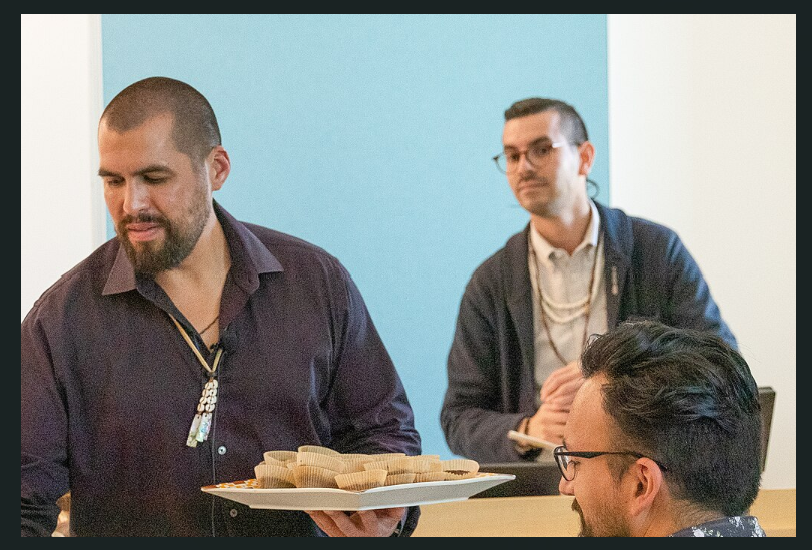
Photo: Native American chefs from Berkeley's Cafe Ohlone visit Chemical Engineering Assistant Professor of Teaching Glaucia Helena Carvalho do Prado's new food engineering course to talk about Ohlone food and culture. Photo By: (Nikita Mistry / UC Davis), Wikimedia
An elder who was incarcerated during her childhood in Manzanar Japanese Internment Camp told me that it’s not possible to hate anyone once you know their story. She likened her experience of being swept up by the American government as a young Japanese-American child and placed in an internment camp, to what brown people in the United States are being forced to endure today when they’re placed in ICE detention centers. The problem is that when people don’t understand the stories of people–in their nuanced, multifaceted, contextualized way, it’s indeed easier for stereotypes, generalizations and half-truths to creep in. It’s also possible for those who are th?e subject of undertold stories, whose voices are not being amplified to feel systemically sidelined. This is why, when I was offered an editing fellowship aimed at helping to center and amplify stories about and voices of California’s Native and Indigenous populations, I accepted the opportunity with humility and honor.
In doing this work, I’m constantly reminded how interconnected we all are and often think back to Audre Lorde’s quote: “There’s no such thing as a single-sided issue because we do not live single issue lives.”
Intergenerational Struggles
This summer, I met a beadwork artist named Alishaw, who had experienced domestic violence, drug and alcohol addiction and a bout of incarceration. Now, as the mother of five and grandmother of ten, she’s trying to sustain herself selling her handmade jewelry but constantly bumping up against law enforcement as she doesn’t have the funds necessary to get a permit. When she was raising her five children, her lack of a tribal enrollment number, made her ineligible to get subsidies for childcare services. It wasn’t until she was released to a women’s program in Ventura that she got connected with the tools and resources she needed to find her path to recovery. She’s since been chipping away at a social work degree at Mendocino community college in hopes of one day working with Native youth, so that she can change the trajectory of their lives.
Voting
I’ve interviewed Native ‘get out the vote’ policy experts who’ve discussed intergenerational voter disenfranchisement that have kept some people away from voting polls. I’ve attended a virtual ‘Tribal Consultation’ over the US Census bureau’s proposal to remove questions about race, ethnicity, tribal affiliation, during which all tribal representatives unanimously voiced opposition to the proposed changes. I’ve learned about the lack of accessible prenatal and postpartum care for Native mothers, the implications of clinic closures in rural communities, the vetoing of laws that would’ve preserved water rights, the affordability crisis and so much more.
Joyful Resistance
I’ve also had the pleasure of bearing witness to a joyful act of resistance ahead of Indigenous People’s Day, a day which President Trump removed from the federal holiday calendar last year. As organizers and participants repeatedly stated, the act of showing up, dancing, moving in synch with the drums that symbolize the heartbeat of the earth, is an act of resistance. One 41-year-old man, who identified only as Alex, got emotional when I asked him about the importance of the day and what he wanted people to know about him. He described feeling like an outcast during his years at Berkeley High School and broke into tears when he talked about the weight of intergenerational trauma that has caused him to sometimes cope through alcohol. After our interview, when Alex asked me if I knew of resources, I pulled up the link for the virtual Red Road recovery group for Natives run through the Mending Basket Resource Center in Willits, Calif. that another interviewee taught me about.
What’s in a story?
The stories that I’ve mentioned barely scratch the surface. As Rose Davis, from Indian Voices, can and will tell you, our stories are interconnected and they matter. As I’ve found in my years as a media worker, an advocate and a single-mom of biracial children, and the daughter of a janitor and elementary school teacher, is that our stories, when shared, have the capacity to change perspectives or even, lives. I’ll be working with four Native American newsrooms, including Indian Voices, over the next year. If you have a story or an issue that needs a light shone on it, we’d love to hear about it. If you’re a youth with a passion for storytelling or an interest in helping to amplify important stories from your community, we want to hear from you.