
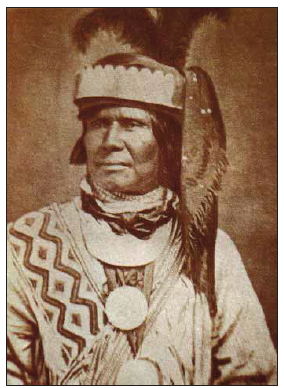
Photo: In 1837, Black Seminole leader Abraham led the first group from Florida to Indian Territory
The Black Seminole leader John Horse may be the best known of all their great war chiefs who fought for freedom. Precise records are not available, but he was likely born in Florida between 1810 and 1815. John was a military leader who fought in Florida, Indian Territory, Mexico, and Texas. Additionally, John was a skilled diplomat who participated in negotiations in Florida, Washington DC, Oklahoma, and Mexico, to facilitate peace and freedom and make good on the promise of a Seminole reservation (with a free zone for Black Seminoles) in Indian Territory separate from the Creeks’ lands. John executed, possibly, the single largest slave escape in the historical records of the Underground Railroad. He led as many as 150 Black Seminoles from Wewoka in Indian Territory (Oklahoma today) to Mexico. The route was an approximately 700-mile journey and hundreds more would follow his pathways before the Civil War. John’s military and diplomatic activity may have covered a range of up to 2,000 miles. In a geographic sense, his travels can be identified as “The John Horse Trail.”
More broadly, the John Horse Trail has a direct link to early American policy. After the American Revolution, President Washington determined that United States development (as was the case with the British before them) in the Carolinas and Georgia was severely restricted by Spanish colonial policies. Therefore, Washington ordered Secretary of State Thomas Jefferson to negotiate with Spain to bring an end to their 100-year destabilization policy, in which they provided land and freedom to any British (and now American) slaves who escaped to Florida. King Charles II of Spain had issued the Edict of 1693 to be administered by the Spanish governor of Florida.
Between 1693 and the French and Indian War in 1763, hundreds of runaway slaves arrived in Florida from Georgia and the Carolinas. The runaways were called “maroons,” which came from the Spanish word cimarrón, meaning “wild beasts” or “runaways.” These maroons were key predecessors and a vital part of the Black Seminole legacy. The victorious British took possession of Florida after the French and Indian War. Nonetheless, in the 70-year Spanish enforcement of the Edict of 1693, the Florida maroons participated in the Yamasee War (1714-16) and the building of Fort Mose in 1738, and they were key participants in the War of Jenkins Ear (1739-40). These events were essential to the Spanish’s ability to put limitations on British colonial expansion in the Southeast.
At the end of the American Revolution, the United States, France, and Spain w?0ere victorious allies. Washington, however, knew the devastation caused by the Edict of 1693. He wanted to capture the hundreds of Florida maroons, whether property of American citizens or former British. To accomplish his goals, Washington negotiated treaties with Spanish Florida and the Creek Nation, including the Lower Creeks and Seminoles. The terms of the treaties required them all to capture and return Black Seminoles to the United States. Also Washington was determined to remove Florida as the refuge of runaway slaves and maroons. The lack of successful outcomes in the enforcement of these treaties resulted in the Patriot War from 1811 to 1813, the occupation of Fort Negro in 1815, and the First and Second Seminole Wars (1817-19 and 1836 -1845). Ultimately, to facilitate the end of the Second Seminole War, the Articles of Capitulation were negotiated between the U.S. commander of Florida General Jesup and the Black Seminole War Chief Abraham. In basic terms, Black Seminoles agreed to stop fighting and accept military escorts to Indian Territory in exchange for freedom on Native Seminole land.
In 1837, Abraham led the first group from Florida to Indian Territory. John Horse led the second group in 1842. Both groups sailed out of Tampa Bay into New Orleans, then up the Mississippi and Arkansas rivers to Indian Territory. When John Horse arrived in Indian Territory, he found that there was no land for his people. Their freedom was even challenged at gunpoint. There were various representatives of the Southern slave business, roaming around them and seeking to take possession of Black Seminoles as valuable slaves. To protect his people and solidify the Articles of Capitulation, between 1844 and 1846, John made two trips to Washington D.C. On the second trip, John spent a year in the nation’s capital. During this second diplomatic mission, John met with high-ranking military leaders and some politicians. At times, he was given accommodations by members of the free Black community. John sought an unofficial meeting with President Polk, but it’s unclear if such a meeting ever happened. John even met with General Jesup, the retired commander of the Second Seminole War who previously made promises to the Black Seminoles.
However, John’s diplomatic efforts did not secure freedom or land. By 1849, it was clear that, in general, freedom could only be maintained by constant battle with multiple groups in Indian Territory. Consequently, they fought their way out of Indian Territory and, at times, all the way to the Rio Grande. John embarked on the perilous journey to freedom with the Indigenous Seminole leader Wild Cat, who was leading anywhere from 200 to several hundred Indigenous Seminole and Kickapoos to new lands in Mexico. John brought approximately 200 Black Seminoles on the seven-month journey to freedom. The travels from Wewoka to Mexico can be seen as the final stage of the John Horse Trail. Perhaps more important though, like a stream can break a new course to the sea, John established a freedom pilgrimage which yielded the most important commodity for slaves—freedom. Thereby until the Civil War, hundreds of runaway slaves successfully evaded the original treaty goals established during the Washington administration, which was to suppress freedom. The Second Seminole War ultimately restricted the Florida freedom sanctuary, which had existed since 1693; nonetheless, the John Horse Trail provided a new route—to a new sanctuary—until the demise slavery in the United States of America.


