
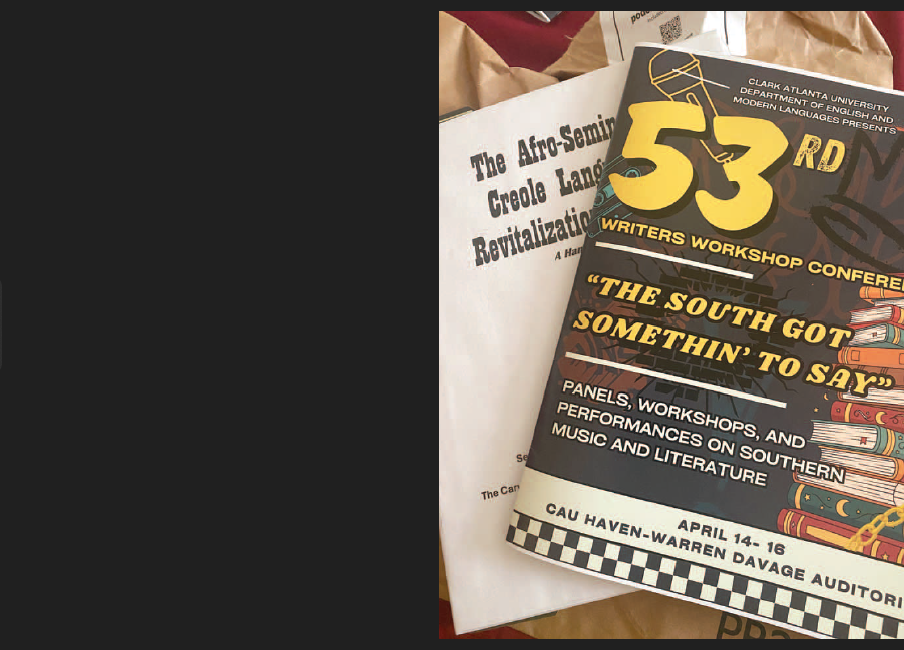
For the past 52 years, Clark Atlanta University’s Department of English and Modern Languages has held a Writers Workshop Conference. This year, I was invited to attend the 53rd annual gathering which was titled “The South Got Somethin’ to Say”: Panels, Workshops, and Performances on Southern Music and Literature. It took place from April 14-16 at the CAU Haven-Warren Davage Auditorium.
In his letter addressing the conference’s attendees, Dr. Christopher K. Bass, who is the interim dean for the School of Arts and Sciences, stated that the workshop’s theme was inspired by Andre 300’s quote at the 1995 Source Awards. He also stated that past conference writers and scholars have included Maya Angelou, Sonia Sanchez, Gwendolyn Brooks, Ruby Dee, Ossie Davis, James Baldwin, Dick Gregory, Gil Scott-Heron, Pearl Cleage, and Terry McMillan.
On the 14th, there was a poetry slam. It took place from 6-9PM and was hosted by Kyra Pollard and Jave’l Wilson. Music was provided by DJ Greg Wilson. On the 15th, the first set of panels took place. Speakers included Ernie Suggs, Jason Walcott, Dr. Molly Slavin, Dr. Jayme Canty, and Dr. Natasha Bailey. On the 16th, the first panel discussed the language, literature, and lyrics of the South. The speakers were Dr. Regina Bradley and Dr. Mack Curry, and the moderator was Prof. Shari Trusclair.
The title of the workshop that I was a part of was called the Afro-Seminole Creole (ASC) Workshop. Dr. Tamala Simmons and I were the presenters. Dr. Simmons began our presentation by giving a brief history of the Black Seminoles. And I discussed Afro-Seminole Creole.
While many people know about the origins and history of the Black Seminoles, not many people know about the language that they carried with them from La Florida to the Bahamas, Oklahoma, Mexico, and Texas. While they had to leave so much behind, Afro-Seminole Creole, which is a close cousin to Gullah Geechee, was something that the Black Seminoles were able to take with them. And the language is a testament to the strength and resilience of a people who were forced to move several times in search of a safe place to call home. With each new place they traveled, the language evolved as words from whatever the dominant language was were added to it. By the time they moved into Texas, Afro-Seminole Creole had become a language that mirrored the diversity of the people who spoke it. It is an English-based Creole with loan words from African languages, Indigenous languages, and Spanish.
After our presentation, the audience asked some amazing questions about ASC. They were interested in how to learn more about ASC and how to incorporate it into their writing. Their questions also prompted me to think about how I can be a better steward of the revitalization of this beautiful, sacred language. I am so thankful to Dr. Tamala Simmons for the invitation to be a part of this important annual event. I came away from this experience being inspired and humbled by these young brilliant minds that are on the precipice of positively changing the world.


