
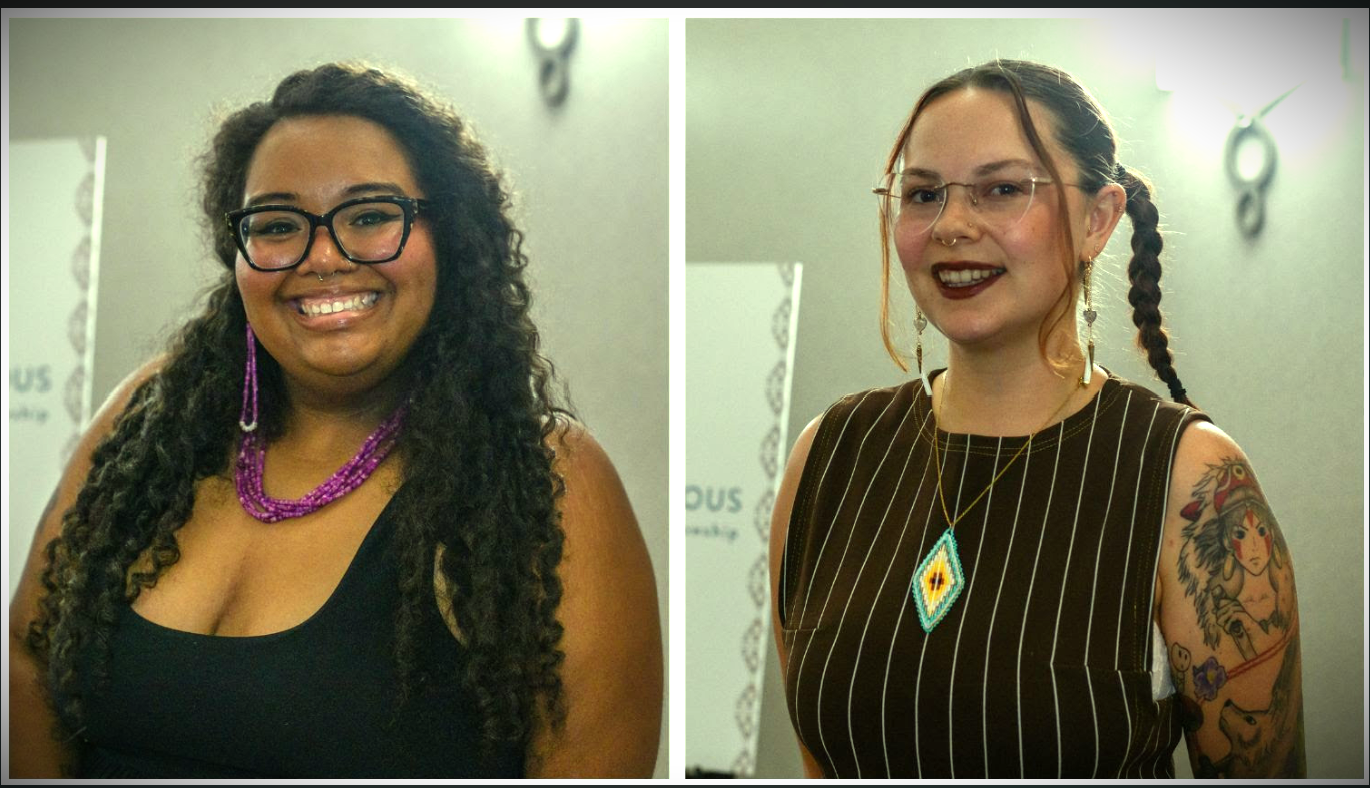
Photos: Lyric Aquino, who is Pueblo of Ohkay Owingeh with Isleta Pueblo and Jicarilla Apache descent, and Nika Bartoo-Smith, who is of Osage and Oneida descent, both cover Indigenous communities in the Portland area. Photo by Kalani Chai-Andrade.

Portland is home to the ninth-largest urban Native population in the country, with residents from more than 380 tribes, yet Indigenous voices remain largely absent from the city's major newsrooms. The journalists working to close that gap are navigating challenges no journalism class prepares you for: What to do when your community is also your beat, when an editor asks you to soften a story or when covering trauma means carrying it home with you.
Lyric Aquino, who is Pueblo of Ohkay Owingeh with Isleta Pueblo and Jicarilla Apache descent, and Nika Bartoo-Smith feel the weight of these tensions firsthand. Aquino reports for Underscore Native News, while Bartoo-Smith, born in Portland and of Osage and Oneida descent, splits her time between Underscore and ICT (Indian Country Today). Both have spent years reporting in a media landscape that has often reduced Native stories to stereotype or spectacle.
“I quickly realized that I wanted to do something that made a difference, and journalism felt like a way to do that," Bartoo-Smith said. "When journalism is done correctly, it can and should do all the things we say it should, right? It should hold power accountable. It should uplift stories that are often left untold or are told incorrectly and misrepresented."
At a smaller publication, Bartoo-Smith's beat widens by necessity, doing art features, youth profiles, investigative journalism and accountability pieces. “A lot of the work is about building trust, because we're reporting for communities that have every right not to trust the media. So the question becomes: How do we earn that trust first? I really appreciate that I'm reporting in the community I come from. "
Aquino arrived at the work from a different angle — as an Afro-Indigenous woman who became interested in journalism at a young age. For Aquino, taking up community coverage became the point. "Being Indigenous is quite literally my whole identity, and I knew I wanted to be able to cover those topics and issues that were in my community that I wasn't seeing covered. So when I was in undergrad, I joined IJA (formerly known as NAJA)."
For Bartoo-Smith, mainstream journalism education was not always helpful. "Honestly, a lot of my first year reporting — and even still today — has involved unlearning many of the things I learned in journalism school,” she said.
The ability to cultivate trust is also an ethical responsibility, she added. "I don't think journalism school really teaches us how to build trust. In mainstream journalism, it sometimes feels like: 'How do we build trust so we can get the story?' Instead, I want to build trust because this person is a human being. It's a privilege that someone wants to share their story with me. It isn't my right to have their story."
Aquino sees the double standard clearly. "I think this is something that only gets asked to Native people. When there are white reporters, people aren't asking, 'oh, how are you covering your community?' I don't think being Indigenous makes it any more difficult."
In terms of non-Native coverage of Indigenous affairs, both journalists cite that coverage from outside news outlets tended to lack authenticity, rather than preserving the narratives of Indigenous communities as they were.
Aquino sees Underscore filling that gap directly. "There are a lot of Indigenous issues in Portland that we might be the only ones looking into, at Underscore Native News."
Bartoo-Smith frames that role in more structural terms. "Underscore Native News is the only outlet dedicated solely to Indigenous affairs coverage in the Pacific Northwest. We're telling stories that no one else is consistently dedicated to telling. For a long time, we almost served as the Indigenous affairs desk for regional news outlets, because they would republish many of our stories. The difference is that Indigenous affairs isn't just one desk for us, that's our entire newsroom."
For non-Native reporters looking to do better, her advice starts with homework. "Educate yourself. Don't rely on Indigenous communities to educate you. That isn't our job. You also have to be willing to learn and unlearn things you were taught in journalism school.
"If you're covering Indigenous affairs, get involved with IJA," Aquino added. "Look at their guides, see if you need to talk to one of the board members, see if there's training available. If you don't have that training as an editor, you need to get it, and have the sensitivity to really understand and listen to your reporters."
Story-sharing guidelines: News organizations are welcome to republish Indigenous Journalism Fellowship stories without charge. Please retain the bylines and photo credits. Do not make major edits beyond adjusting dates and making style changes that suit the needs of your publication. IJA appreciates receiving a link or copy of the published story, which you can email to mary@indigenousjournalists.org.


