“The American Journalism Project’s Product & AI Studio team is fresh from the 2026 News Product Alliance Summit, which gathered in Chicago in October with practitioners in product, audience, technology, revenue and editorial departments. Together they discussed news products that respond to what audiences actually need, as well as the infrastructure required for those products.
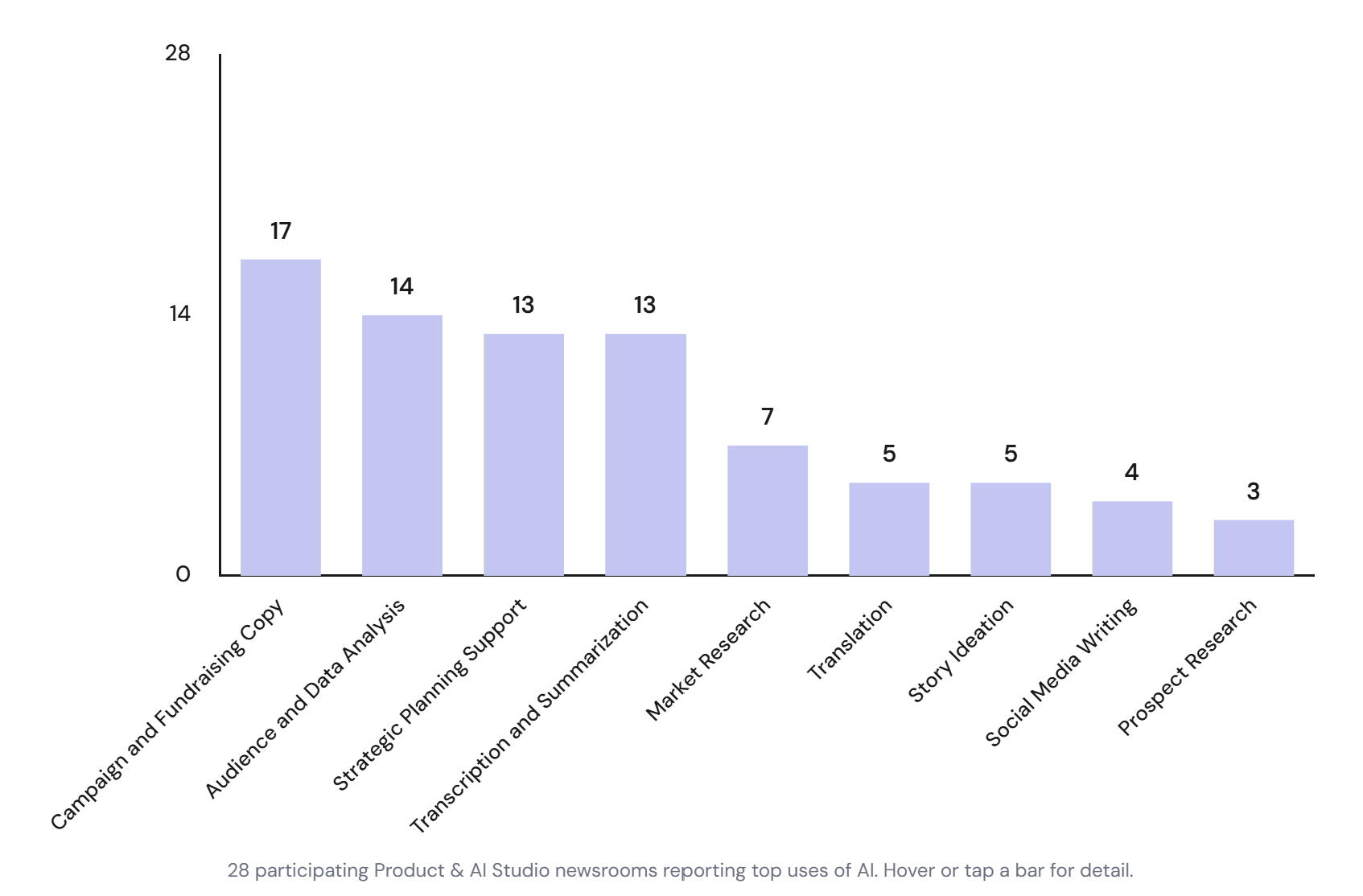
We were especially excited to learn about new uses for AI in local news. Nine of our own portfolio organizations presented their work in this realm, engaging with attendees on topics as diverse as rapid prototyping, measuring impact and smart audience strategy. From translating stories into new languages to coaching leaders through fresh fundraising drives, AI adoption in local newsrooms – both within our portfolio and across the broader field – is coming into focus.
Civic News Company used Al-powered analysis tools to siftthrough large volumes of information and surface story ideas that reporters mightotherwise have missed, allowing journalists to spend more timereporting and developing stories.
Across these experiments, AI delivered its clearest value by reducing repetitive work and giving small teams more time for the work only humans can do. Participants in our cohort used LLMs to handle first drafts, transcription, translation and data processing, allowing them and their teams to focus on reporting, strategy and relationship-building. These improvements resulted in increased cost savings, more efficient fundraising and, most importantly, enhanced products for local communities. In the process, we identified three requirements for successful AI integration: capacity, workflow fit and context.”
“Michelle Everhart-Sullivan, chief audience officer at Signal Ohio, found that the organization’s small team could do more by using AI to remove one of the most time-consuming parts of the fundraising process: drafting campaign copy.
At Signal, the audience team supports fundraising for three newsrooms in Cleveland, Akron and Columbus. When BlueLena, a services and technology firm many AJP portfolio organizations partner with to increase reader revenue, challenged them to run fundraising campaigns every week, the goal felt out of reach for a small staff already juggling multiple responsibilities, Everhart-Sullivan said.
Using BlueLena’s AI Campaign Assistant, a dashboard configured to support fundraising work, the team reduced the time spent drafting fundraising emails and campaign messaging, removing one of the biggest bottlenecks in its workflow.”
“Like much in product development, we found that scope mattered. Our most successful newsroom experiments first identified where newsroom work slowed down. Then they tested if and where an LLM-driven workflow could help in targeted ways, avoiding overly broad experiments. This generated AI solutions that were custom-fit for the needs of specific newsrooms.
In Chicago, City Bureau designed and launched a tool called the Contextualizer to generate briefs about past meetings. The tool identifies recurring speakers and flags procedural norms for its Documenters program.”
“Newsrooms quickly found that the strongest AI outputs came from a better organizational context. As newsrooms experimented with AI, they discovered that general-purpose Large Language Models (LLMs) like ChatGPT needed more context about their reporting, fundraising strategy, editorial voice or audiences.
Through experimentation, they found that LLM outputs improved dramatically when newsroom culture, voice and institutional knowledge were grounded in the LLM’s context. For a newsroom, that might include its style guide, mission, audience research, past campaigns and examples of successful work.
Clare Dignan, chief growth officer at CT Mirror, said one challenge her team faced was adding context in a way that provided clear direction for ChatGPT outputs. ‘ChatGPT didn’t know CT Mirror, it didn’t know how we talked, or our impact,’ Dignan said. To address this problem, they used the funder communications tool created by Open Campus to bridge the gap and translate institutional knowledge into clear communications for funders.”