
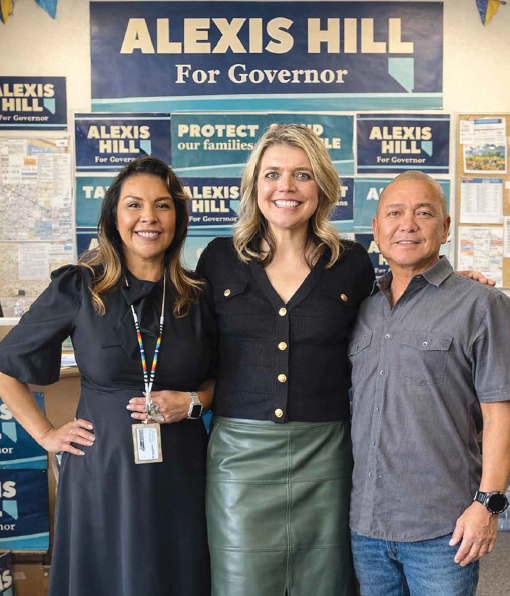
“My whole life, growing up in Nevada, we have been on the bottom of the good listand the top of the bad list, and we continue to admire that problem instead ofactually electing people who tell us how they’re going to get us out of that,”Hill said.
Hill, a Washoe County Commissioner, said her day-to-day work puts her face-to-face with the gap between what Nevadans live and what state government delivers.
“I see people who are suffering in our communities, who need real help,” she said,“and we do not have a state government that is modern, that is resourced, orthat is focused on actually improving their lives.”
From her own account, that distance between lived reality and state inaction is thecore reason she’s running.
A cycle of economic “quick fixes,” not long-term investment
Hill argues Nevada repeats the same pattern: when the economy turns down, leaders chase a marquee company rather than invest in people already here.
“Everytime there’s a recession, we’re back at the highest unemployment in the UnitedStates,” she said. “We think we’re going to incentivize a big, rich company to come into town, and we think that will answer all of our issues. And it doesn’t.”
She frames her candidacy as a push to break that cycle and redirect attention tocommunity-level stability.
“Wehave to stop pretending that the next big corporation is going to save us,”Hill said. “We need to invest in Nevadans our small businesses, our schools,our health care, our housing, our roads and transit. Nevadans deserve that andthey deserve that change.”
In her own words, she wants Nevada to shift from “chasing headlines” to “buildinga real foundation” for the people who already live here.
Tribal nations “at the table, not as an afterthought”
Hill is explicit that Nevada has failed Indigenous peoples and tribal nations by treating them as an afterthought.
“Our Native American tribes and Native American tribal members are not at the tablein the way that they need to be,” she said. “They’re typically an afterthoughtwhen you’re looking at any sort of investments in communities or infrastructurechanges or resources.”
She ties her run for governor to changing that relationship from the beginningbefore projects or policies are finalized.
“If I’m going to ask for this job, it has to mean tribes are partners from thebeginning,” Hill said. “Not people we call when the deal is already done.”
Hill said she wants to:
•Create a formal tribal council that reports directly to the governor
•Place tribal members inside the governor’s cabinet and across state agencies
•Make early tribal consultation automatic for roads, land bills, flood control,and economic development that affects tribal lands or sacred places
“I’m running to make sure tribal governments are treated as governments,” she said, “not as an interest group we check a box on.”
Shealso said she intends to “sit with every tribal council in Nevada” to hear directly what leaders need on water, land, housing, mental health, and public safety including Missing and Murdered Indigenous Peoples (MMIP) and to carry those priorities into the governor’s office.
A tax system she calls “upside down”
Hill connects Nevada’s underfunded services to a tax structure she believes shifts the burden onto working families while letting major power centers avoidresponsibility.
“Right now, the people with the most power are not paying their fair share,” she said.“We lean on gas taxes, sales taxes, registration fees things that hit thepoorest Nevadans the hardest while we let big players off the hook.”
She says the governorship is where meaningful statewide tax reform can happen.
“Asa county commissioner, I’m patching holes,” Hill said. “As governor, I want tofix the roof. We have to modernize our tax code so we can actually fundschools, health care, infrastructure, and investments in tribal and ruralcommunities.”
She frames her campaign as an effort to “stop asking the poorest Nevadans to carrythe heaviest load.”
Safety, visibility, and the MMIP crisis
Hill also links her run to public safety and to whether Nevadans particularlyIndigenous communities feel seen when harm occurs.
In our conversation, we spoke about Missing and Murdered Indigenous Peoples and the broader climate that makes Indigenous women, girls, and Two-Spirit people targets for violence and trafficking.
Hill said she wants MMIP treated as a central state priority, not a peripheral issue.
“If we’re not counting people, if we’re not tracking cases, if we’re not resourcing investigations, we’re saying with our actions that their lives don’t matter,” she said. “I’m not okay with that. I’m running because I want a Nevada where Indigenous families feel seen when something happens, not invisible.”
She extends that concern to immigrants and long-time residents who, she says, no longer feel government is on their side.
“Everyone wants to feel safe,” Hill said, “but right now too many people feel like they are on their own.”
“Real people” in the room where decisions are made
Hill is blunt about the political culture she says she wants to change who gets access, who gets heard, and whose experience counts.
“We have a lot of elected officials who are more comfortable at fancy events tha non a regular street,” she said. “We need to make sure we’re getting electedofficials who are actually with real people and actually want to hear what isactually happening in our state and feel it.”
Shesays she would prioritize lived community connection when choosing leadershipand key staff.
“It’s not necessarily based on whether they have a degree,” Hill said. “It’s based on if they are embedded in community and understand the issues on the ground, havea passion for making things better, and have the ethics and moral compass to doit right.”
Hillsaid she is hosting “Ask Alexis Anything” events and open houses and is inviting scrutiny.
“I want people to come and ask me anything,” Hill said. “They can video me. They can record me. I’m an open book. I am not hiding from really tough questions.”
A sa working mother who has wrestled with childcare, housing for loved ones, and access to health care, she said she wants policy makers who “live what Nevadan slive.”
In her own framing
Hill does not present her run as a neutral career move. In her own words, she is running because:
•Nevada keeps landing “on the bottom of the good list and the top of the badlist,” and she is “tired of admiring the problem.”
•Tribal nations are treated as an afterthought, and she wants them at the center of state decisions as equal governments.
•The tax system is “upside down,” asking the least to carry the most while the state starves its own communities.
•Indigenous families and many Nevadans do not feel safe or visible especially inthe MMIP crisis and she wants the state to finally look directly at thatreality.
•“Real people” must be in the room, not just people with connections andcredentials.
Those are the reasons Hill gives for asking Nevadans to make her their next governor.


