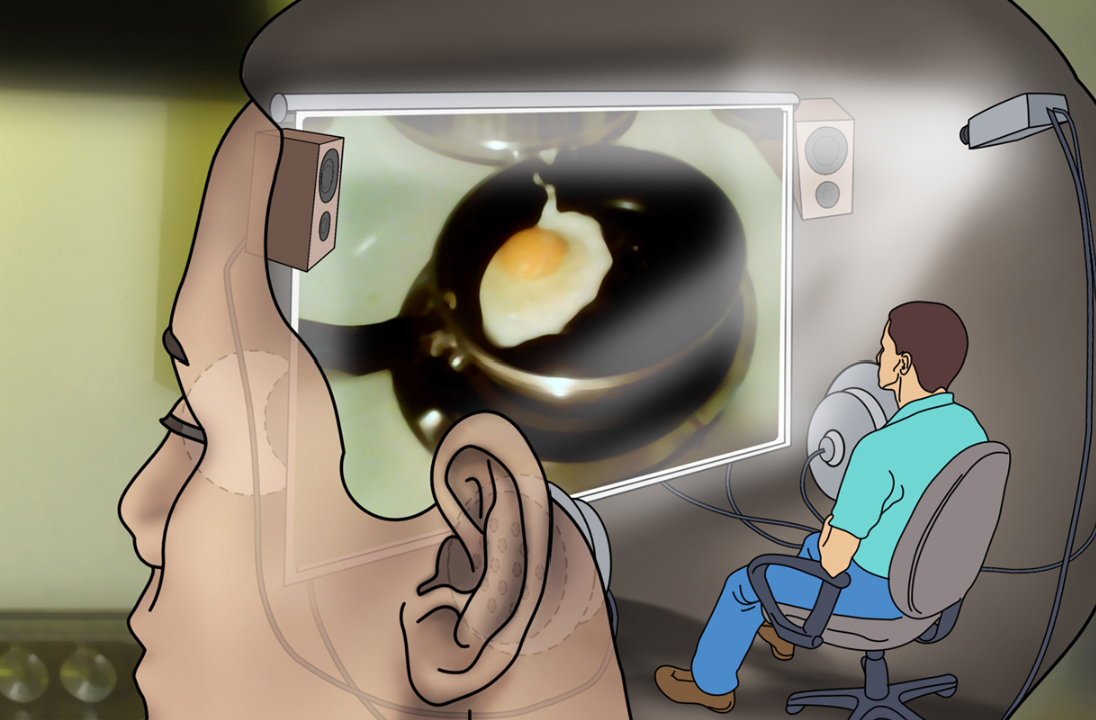
Image: A tiny person sits in a movie theater inside a human head, watching and hearing everything that is being experienced by the human being. An illustration of the Cartesian theater, by Jennifer Garcia, Wikimedia
In the summer of 2018, the supposedly hip and radical-chic Madison, Wisconsin, held a reunion for all 1960s graduates (madisonreunion.com). I was living in New York and thought, “What a great opportunity to showcase my rollicking hippy movie”—a much-loved but mostly ignored piece of celluloid. But, alas, the curator of the cinematheque refused to grant a screening. I was understandably confused. After all, I was from Wisconsin (raised in Milwaukee), had graduated from UW/Madison in 1963, and the film was made in the sixties (1968). A trifecta-perfect fit, so I thought.
The rejection was beyond insulting. I was momentarily stunned. Scores of people had worked on this liberating message to reach beyond the suffocating humdrum of a corporate-dominated world. My frustration was palpable. It spurred me to analyze censorship in all of its destructive guises—governmental, corporate, institutional, and algorithmic.
Flashback to culturally vibrant San Francisco, 1969: Many local, independent filmmakers enter their films into the San Francisco Film Festival. All are rejected. In protest, a group of filmmakers stage a pie-throwing street theater event outside the venue.
As it turned out, Hollywood had designs on the liberated city to their north. Two young filmmakers, carefully groomed in Los Angeles film schools, are packed off to the Bay Area. They arrive with buckets of money, and an elaborate, state-of-the-art studio named Zoetrope is built for them. A young George Lucas brings his cheap AI storytelling and launches the Star Wars franchise. The films are little more than glorified war porn for children. Francis Coppola finds a mob-inspired vehicle that becomes a staple of the industry for the next half century. The financiers who back these films use the same mob-like techniques to rub out the competition.
Shut off from any domestic distribution, a decision is made to take “GOLD” overseas, where it finds a charming Irishman named Ronan O’Rahilly, a music impresario who owns Radio Caroline, a pirate radio station that broadcasts throughout Europe from the North Sea. Ronan is dogged by the British government, which is bent on controlling the distribution of all airwaves. “GOLD” comes up against government censorship, which puts immense financial pressure on the producers. After repeated clashes and continuing harassment, the film dies at the box office. End of story, almost.
I began to distinguish between government censorship and the highly paid corporate and institutional gatekeepers who know what their bosses want and don’t want without being told. In 1967 a Ramparts magazine article exposes “the mighty Wurlitzer,” which is a CIA-inspired phrase that describes infiltrating domestic organizations in order to control and spread propaganda (“The Mighty Wurlitzer—How the CIA Played America” by Hugh Wilford, 2008). A 1976 Rolling Stone article by Carl Bernstein reveals “Operation Mockingbird,” a highly sophisticated network of media workers controlled by the Central Intelligence Agency. So-called “journalists” had abandoned their credo to hold power accountable. The CIA has surreptitiously been appropriating our culture. Hollywood, their willing executioner. Well-researched studies begin to expose the hidden hand: “The Collaboration: Hollywood’s Pact with Hitler” by Ben Urwand, “Operation Hollywood: How the Pentagon Shapes and Censors the Movies” by David Robb, and “National Security Cinema” by Mathew Alford and Tom Secker, among others. These books reveal a clear picture of blanket censorship and media manipulation.
Since its invention, film has been inherently political. The power of the visual image to sway emotions is undeniable. President Woodrow Wilson championed and screened at the White House the overtly racist screed The Birth of a Nation released in 1915. And who among us hasn’t seen the power of television, which catapulted our current president straight from The Apprentice?
It seemed, for a brief moment, that the internet might free the airwaves, but sophisticated and nefarious algorithms have been quickly developed to control the narrative and keep the power in the hands of a few Silicon Valley billionaires. You, reader, and I are the targets. We are prey.
I can bellyache about having my film career eradicated and what it might have cost me over the years—compensation, absence from anthologies, sponsorships, speakers’ fees, etc...but the not-so-subtle censorship of “GOLD” pales in comparison to what media manipulation has meant for Blacks, Browns, and Asians. Hollywood has a horrible record of exclusion. Step-and-Fetchit, Speedy Gonzales, and Charlie Chan typify a decades-long practice of stereotyping.
The Virtual Lynching of Harriet Ann Jacobs
Ask yourself, “Have I ever heard that name before?” Most likely you know another Harriet. Harriet Beecher Stowe. She wrote Uncle Tom’s Cabin, which unveiled to millions the cruelty of slavery. But her story was imaginary. What Harriet Ann Jacobs writes is real, not fiction. With gut-wrenching eloquence, she gives us a passionate, first-hand account of the brutality of slavery and her escape to freedom. Friends with Frederick Douglass, her memoir was published in 1862, but mostly ignored until the 1960s. How was this allowed to happen? With all the history departments at universities and colleges across the nation, why didn’t some scholar pick up on the significance of her heart-breaking tale? How can such a vital document be overlooked for over a century!? Humans have unlimited potential, but if we are deprived of knowing the heroic achievements of our fellows, we will continue to stumble in ignorance. Censorship, be damned!