
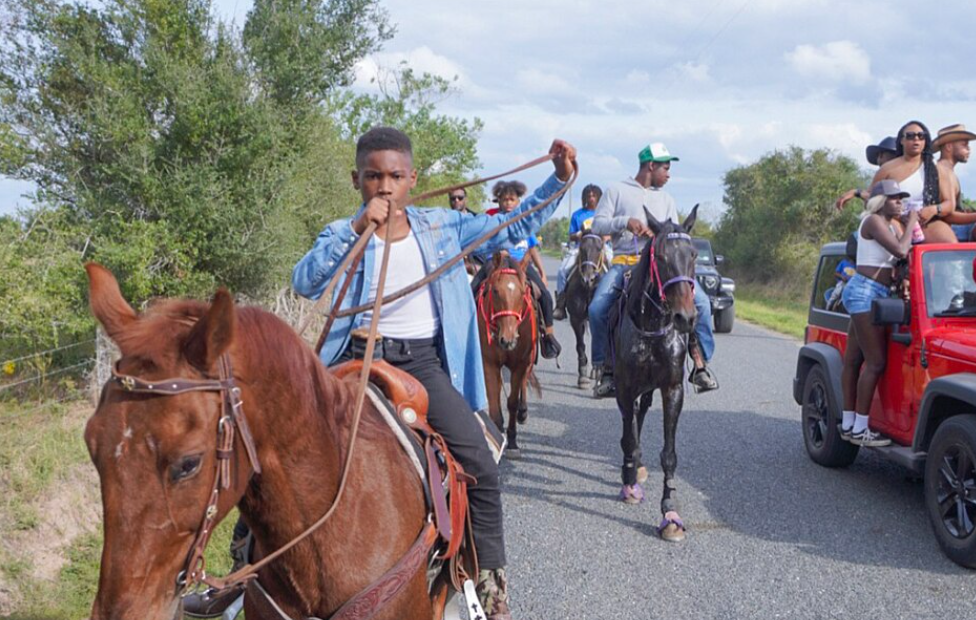
Photo: Black Americans take part in a historic tradition of trail riding that originated amongst their ancestors in Louisiana and Texas, by TheBlackAmerican, Wikimedia
Black Americans are increasingly dropping the term “African-American” to describe our people. In 2020 the U.S. media started calling us “Black” with a capital “B.” That’s how Ebony and Jet magazines, referred to us as far back as the 1970s. Ebony and Jet, both owned by the Johnson family in Chicago, also capitalized “White,” essentially treating both Black and White as ethnic or cultural categories, not just physical descriptions of skin color.
To be honest, Black folks have used the term Black in everyday use even after the term African-American became official in academic circles.
There are many reasons for this change. Ethnic prejudice from black immigrants have soured many Black Americans on the illusions of Pan-African unity. Even worse, African immigrants in the diaspora have exacerbated this by blaming Black Americans for “having no culture.” The hypocrisy of that position is even more pronounced when it was Black Americans who first promoted pan-Africanism, and modeled to the black world how to fight for rights in a non-Black-run country.
Another thorn is the hypocrisy of not requiring other black groups from attaching "African" to their name, i.e., Afro-Haitian, African-Jamaican, etc.
The idea is starting to spread that Black Americans ascend, at least in part, from people indigenous to North America. This includes American Indians who married defined “Negro” partners in the late 1800s, and Indian children enslaved in 1600s Virginia, and dark-skinned Indigenous Yamasee people reported in what became South Carolina in the early 1500s; and many more.
There is much evidence from South America that Melanesians, the black people of the Pacific, were common in South America up until the invasions of the Europeans in 1492. This gives credence to the belief that Black people first arrived in the U.S. southeast from South America via the Caribbean long before Columbus ever saw the West Indies.
Black folks are claiming all of those origins. We are no longer dismissing Indigenous claims out-of-hand, but instead exploring the hidden histories of our own genealogies and numerous local documents that prove the forcing of American Indian families into the Jim Crow “Negro” category.
The term Black Indigenous itself may soon be redundant, as American Blackness itself is already a form of American indigeneity.
See also:
Melanesians Came to the Americas and Left Descendants Here
Melanesians were present in South American Until Colonization, Brazilian Scientists Say
Mysterious Melanesians and Yamasee Indians: Possible Connection?
How the US Recognizes Some Black People as American Indians
The Indian Civil Rights Act (ICRA) Created to Benefit Blacks and Indians
Sources:
Moore, Kianga, “What do we call ourselves? Re-thinking Black Identity in America,” March 27, 2026, Ebony.com
“Intersectional Indigenous Identities: Afro-Indigenous & Black Indigenous Peoples,” February 01, 2022; Native Americans in Philanthropy.https://nativephilanthropy.org/


