
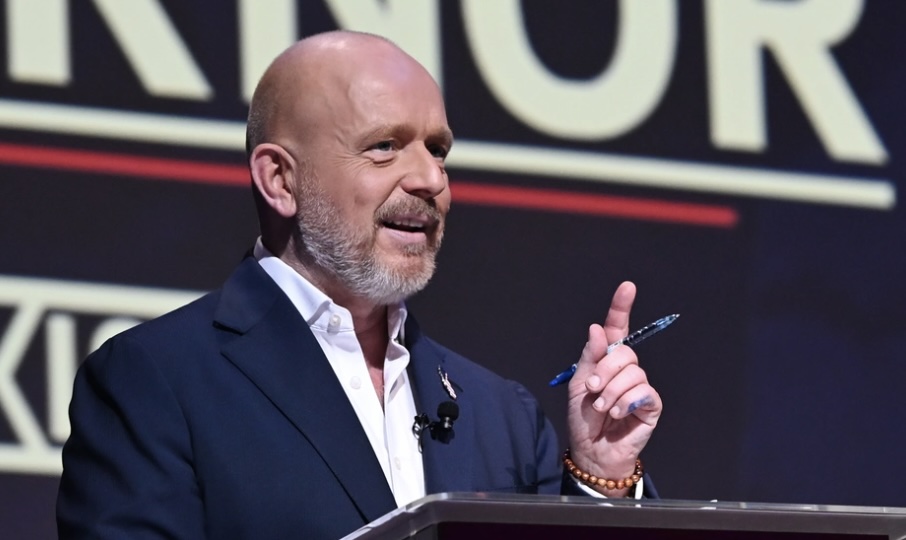
"California has the highest poverty rate of any state. We have the highest unemployment rate of all 50 states. The highest cost of living by far."
Republican gubernatorial candidate Steve Hilton is making a simple argument to California voters: after more than a decade of Democratic control, the state is failing to deliver the opportunity it once promised. Running on a platform centered on affordability, lower taxes, stricter immigration enforcement, and regulatory reform, Hilton says California's biggest problems are the result of government policies rather than a lack of resources or economic potential.
Hilton, an entrepreneur, author, political commentator, and former adviser to British Prime Minister David Cameron, immigrated to California in 2012. The son of Hungarian refugees who fled communism, he frequently references his family's immigrant experience when describing what he sees as the state's declining economic mobility.
"The California dream is just not there for most people," Hilton said, arguing that rising housing costs, high energy prices, and growing economic insecurity have made it increasingly difficult for working families to get ahead.
Affordability remains the centerpiece of his campaign.
Hilton's economic platform includes eliminating state income taxes on the first $100,000 of income, ending California's annual $800 small business tax, eliminating state taxes on tips, reducing vehicle registration fees, and reversing energy policies that he says have contributed to high gasoline and electricity prices. He argues that California's budget contains tens of billions of dollars in waste and inefficiencies that could offset the cost of those tax reductions.
Immigration emerged as one of the most discussed topics.
Hilton repeatedly emphasized his support for legal immigration, describing himself as "a candidate of the legal immigrant community." He argued that immigration policy should remain primarily a federal responsibility and said California should not obstruct federal enforcement efforts.
"The difference you will see with me as governor is that all laws must be peacefully enforced and we will not obstruct the implementation of federal immigration law," he said.
When asked about California's agricultural workforce, where undocumented workers make up a significant share of employees, Hilton argued that the state should focus on increasing workforce participation among unemployed Californians while also embracing technological changes that are reshaping the agricultural sector.
He pointed to automation as a growing force within farming and suggested that many lower-paid agricultural jobs could eventually be replaced by technology. He also criticized what he described as a welfare system that discourages workforce participation among some Californians.
Healthcare policy represented another area where Hilton drew a clear distinction with current state leadership.
He argued that California's hospital system faces growing financial pressures due to regulatory burdens, staffing shortages, and increasing demand for services. He also expressed opposition to using state funds to provide healthcare coverage for undocumented immigrants, saying California taxpayers should not be responsible for subsidizing healthcare benefits for citizens of other countries.
On education, Hilton criticized what he characterized as an excessive focus on political and ideological issues in public schools. He argued that state resources should be directed toward improving reading, writing, and mathematics outcomes, particularly for Black and Latino students, whom he said have been poorly served by the current system.
"If you can't read and you can't do math, you're never going to have the chance of the California dream," he said.
Environmental policy offered another sharp contrast with many of California's current leaders.
Hilton rejected the idea that climate change is the primary driver of the state's wildfire crisis. Instead, he argued that forest management practices, fuel accumulation, and land-use decisions play a larger role in determining wildfire severity. He called for expanded forest thinning, increased use of controlled burns, and fewer regulatory obstacles to vegetation management.
"The forest has been allowed to become overgrown and over-dense," he said. "When you have a naturally occurring fire, it is more likely to become a megafire."
He also linked California's insurance crisis to what he described as excessive regulation and lengthy approval processes that have driven insurance companies from the state. Hilton argued that streamlining regulations and reducing litigation costs would encourage insurers to return to California markets.
Questions about diversity, equity, and inclusion programs prompted Hilton to frame the issue around government spending rather than ideology. He said every publicly funded program should be evaluated according to measurable results and taxpayer value, particularly at a time when California faces significant budget pressures.
Throughout the conversation, Hilton repeatedly returned to a broader criticism of one-party rule in California. He argued that Democratic dominance has reduced accountability and allowed government spending to expand without producing corresponding improvements in public services or quality of life.
While his positions differ sharply from many elected officials currently leading the state, Hilton sought to present himself less as a partisan figure and more as an advocate for governmental reform. His campaign message centers on a belief that California's challenges are solvable if state leaders focus on affordability, economic opportunity, public safety, and what he describes as practical results over political ideology.
For voters, the question may ultimately be whether California's problems stem from the policies that have governed the state for the past decade, as Hilton argues, or whether the solutions he proposes would create new challenges of their own. As the gubernatorial race begins to take shape, that debate is likely to remain at the center of the campaign.


