
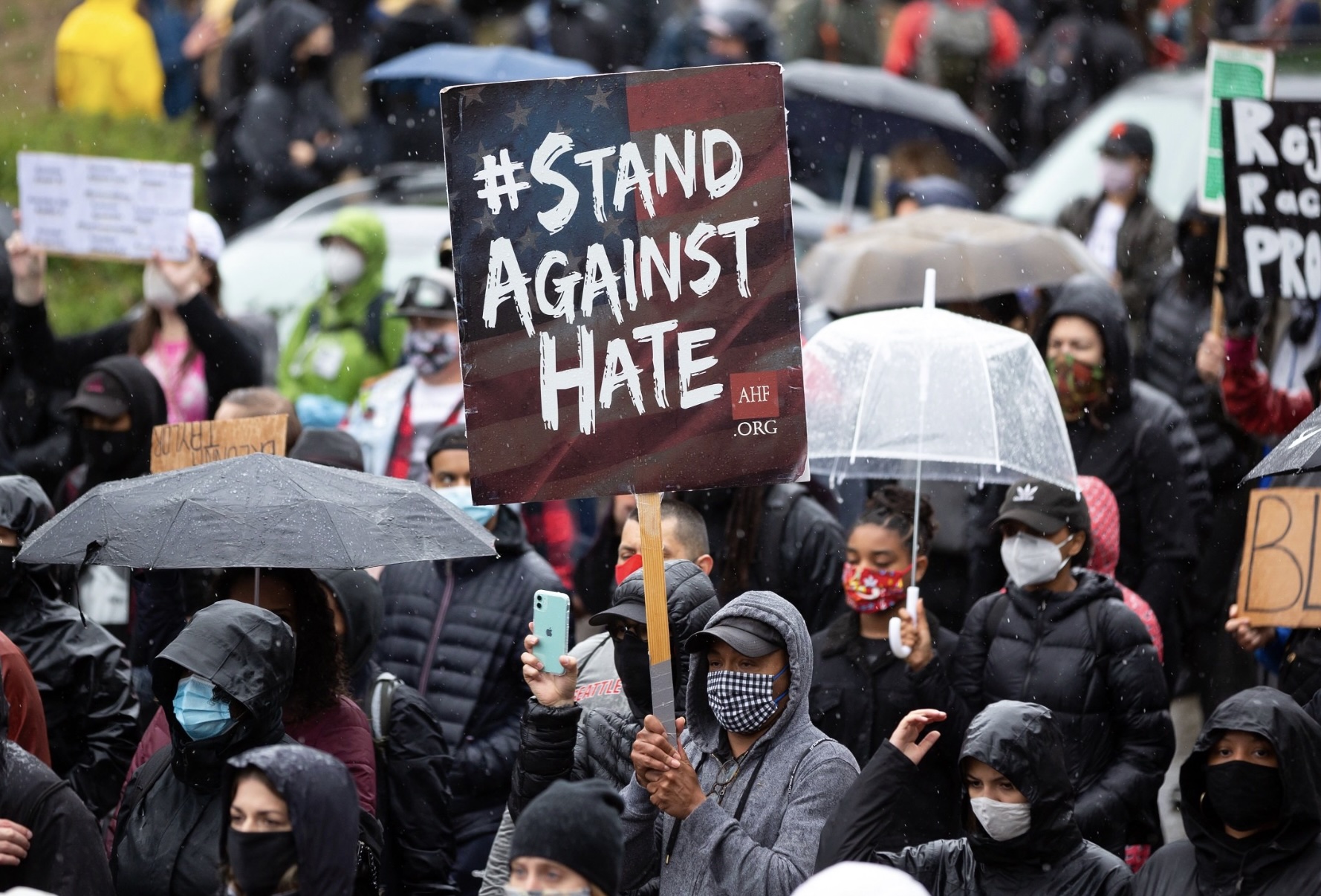
Five years after Congress passed the COVID-19 Hate Crimes Act in response to a surge of anti-Asian violence during the pandemic, advocates say hate incidents targeting Asian American, Native Hawaiian, Pacific Islander, Sikh, Muslim, and South Asian communities remain alarmingly high, while many victims continue to face barriers to reporting and support.
The May briefing from ACOM brought together leaders from several national civil rights organizations to discuss the current state of hate crimes and hate incidents across the United States. Speakers argued that while public attention has shifted since the height of the pandemic, many of the underlying conditions that fueled anti-Asian hostility remain firmly in place.
Opening the discussion, American Community Media Health Editor Sunita Sohrabji noted that anti-Asian hate crimes and incidents remain nearly three times higher than pre-pandemic levels. Citing FBI data, she reported that 833 hate crimes last year targeted Asian American, Native Hawaiian, and Pacific Islander communities, including incidents directed at Sikhs, Muslims, Buddhists, Hindus, and Pacific Islanders. Several speakers emphasized that these figures likely represent a significant undercount because many victims never report what happened to them.
John C. Yang, president and executive director of Asian Americans Advancing Justice, reflected on the 35-year history of the organization and noted that one of its earliest reports examined the underreporting of anti-Asian hate crimes. Despite decades of advocacy, he said the problem remains unresolved.
Yang argued that anti-immigrant rhetoric has reached a dangerous level in the United States and expressed concern that inflammatory language from political leaders can contribute to hostility toward immigrant communities. He referenced recent remarks about China and India and said such language revives long-standing stereotypes portraying Asian Americans as perpetual foreigners whose loyalty to the United States is questioned regardless of how long they have lived in the country.
He placed current debates within a broader historical context, drawing connections to the Chinese Exclusion Act, the incarceration of Japanese Americans during World War II, and the targeting of Muslim, Arab, Middle Eastern, and South Asian communities after September 11. According to Yang, efforts to portray minority communities as threats to national security have repeatedly preceded periods of discrimination and violence.
The COVID-19 Hate Crimes Act was passed in 2021 following several high-profile attacks, including the Atlanta spa shootings that killed six Asian women and the mass shooting at a FedEx facility in Indianapolis that killed four Sikh Americans. Yang said the legislation helped improve language access, expand reporting mechanisms, and support community-based responses to hate. However, he warned that many of those gains are now at risk as funding for anti-hate initiatives faces uncertainty and federal support diminishes.
Much of the discussion focused on the gap between official statistics and lived experience. Speakers repeatedly emphasized that hate crimes represent only a fraction of the hostility experienced by many communities. Harassment, threats, discrimination, and intimidation often do not meet the legal definition of a hate crime but can have lasting effects on victims and their families.
Mannirmal Kaur, senior federal policy manager at the Sikh Coalition, traced anti-Sikh discrimination in the United States back more than a century. She recalled the 1907 attacks against Sikh mill workers in Bellingham, Washington, and described the wave of violence that followed September 11, when many Americans incorrectly associated turbans and beards with terrorism. One of the first deadly hate crimes after the attacks, she noted, was the murder of Balbir Singh Sodhi outside his Arizona gas station. Within the first month after September 11 alone, the Sikh Coalition documented more than 300 cases of violence and discrimination targeting Sikhs.
Kaur said anti-Sikh hate continues to evolve. Drawing on recent research from Stop AAPI Hate, she pointed to increases in online hostility toward South Asians and Sikhs following the 2024 election cycle. She argued that attacks on diversity initiatives, anti-immigrant rhetoric, and efforts to restrict birthright citizenship create an environment where bias and exclusion can flourish.
Sameer Hossain, managing director of the Muslim Public Affairs Council's Washington office, shared several examples illustrating how national events can trigger violence against entire communities. He recounted the 2001 shooting of Bangladeshi American Rais Bhuiyan in Texas and the murder of two other South Asian men by a gunman seeking revenge for the September 11 attacks. He also discussed the 2023 murder of six-year-old Palestinian American Wadea Al-Fayoume in Illinois following the outbreak of war in Gaza. Both cases, he said, demonstrate how individuals can become targets because of assumptions about their identity rather than anything they have personally done.
Hossain reported that his organization recently documented an eleven-fold increase in attacks targeting American Muslims and mosques. He attributed part of the problem to a lack of public awareness about how to report incidents, distrust of law enforcement, and frustration among victims who never receive follow-up after filing complaints.
Stephanie Chan, director of data and research at Stop AAPI Hate, presented findings from a new national survey released during the briefing. The survey found that half of Asian American and Pacific Islander adults experienced a hate act in 2025 because of their race, ethnicity, or nationality. The figure was consistent across East Asian, South Asian, Southeast Asian, and Pacific Islander communities.
Chan said the most common experiences were harassment and institutional discrimination rather than criminal attacks. She also described a shift in the language reported by victims. During the pandemic, many incidents involved accusations that Asian people were responsible for COVID-19. More recently, reports increasingly include threats related to deportation and immigration enforcement. One Korean American woman told Stop AAPI Hate that a stranger screamed that she could not wait for Trump to deport her before physically shoving her. Another report involved a Pacific Islander man being told online that he should prepare his immigration papers despite being a U.S. citizen.
The survey also revealed significant mental health impacts. Nearly three-quarters of respondents who experienced hate reported heightened stress, while only about one-third received any support. At the same time, participation in civic engagement and resistance efforts has declined in recent years. Speakers expressed concern that fear, exhaustion, and uncertainty are pushing many people away from public life at a moment when community engagement is most needed.
Several reporters asked why hate crimes are so rarely prosecuted as hate crimes. The panelists pointed to a combination of factors, including the difficulty of proving bias motivation, cultural misunderstandings, language barriers, and a lack of awareness among law enforcement officers. Kaur noted that an officer unfamiliar with Sikh religious practices may not recognize the significance of a turban being forcibly removed during an assault. Chan added that many victims are told their experiences do not qualify as racism or bias even when explicit slurs are involved.
As the briefing concluded, speakers emphasized the importance of reporting incidents, supporting victims, and strengthening community-based responses. They encouraged witnesses to avoid remaining passive bystanders and urged community members to document incidents, seek support, and connect with organizations that can provide assistance.
Five years after the passage of the COVID-19 Hate Crimes Act, the discussion highlighted both progress and persistent challenges. New reporting systems, public awareness campaigns, and advocacy efforts have expanded resources for victims. Yet speakers repeatedly returned to a central concern: while the forms hate takes may change over time, the underlying patterns remain remarkably familiar. The challenge now, they argued, is not simply documenting hate when it occurs but building institutions and communities capable of preventing it before it happens.


