
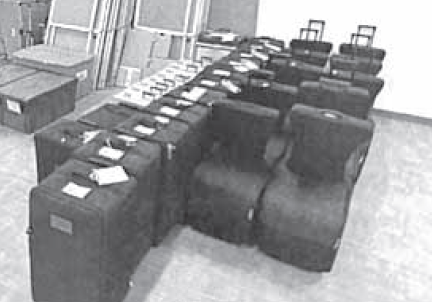
Photo: Polling place equipment ready for set up.
Several changes were made to how poll workers conducted the June 2026 election. These updates are intended to simplify operations and reduce the chance of errors. One major change is that the election effectively begins 29 days before the final vote is cast on June 2, 2026. During this period, voting centers serve as drop-off locations where mail-in ballots are collected and sent directly to election centers for counting and storage. Voters who cast ballots this way receive a text confirming that their ballot was received and counted. Another change is that the term “Provisional Voter” has been replaced with “Conditional Voter Request” or “CVR.” In addition, all ballots are now printed on 8 x 14-inch cardstock, so the Ballot on Demand (BOD) and Automated Voting Unit (AVU) now use a large paper tray for legal-size cardstock.
Poll workers must complete a three-hour class, including one hour of hands-on training, before the election begins. Topics covered include decorum, processing, and team responsibilities. There are seal checks three times a day, and processing tables have Voter Request Cards stored underneath laptops that are located at each table. This is to ensure that each laptop operator processes each voter and that each voter is counted and cross-checked at the end of the day with the three rosters: CURBSIDE, REGULAR, and Conditional Voter Request. Each roster also collects whether the voter used the AVU or the BOD ballot. Each voter request card has a copy dyno printed label showing the voting precinct. The Conditional Voter Request has a Conditional Voter Registration Envelope (orange color) with a dyno label stuck to it with the voter’s information attached.
The hours that a poll worker works are as follows: 1. Class - three hours; 2. SET UP - FRIDAY before election - four hours; 3. Saturday – Sunday – Monday: 0800 - 1800 hours; 4. TUESDAY 0600 - close and put away equipment. The pay is $20 an hour.
On a typical day, the outside team puts out mitigation supplies (signs, curbside bell). They were helped by grammar school children who viewed it as a game. This happened in the morning and at night. A poll worker supervised this short operation. The inside team checked seals, opened the BOD, and filled the AVU printers with paper. Then the poll workers prepared for the first voter by having the ballot drop off, Mail Ballot bag, Blue drop off ballot box, and roster opened. A poll worker announced, “Hear Ye, Hear Ye. The polls are now open.” The first voter is a regular voter who signs the roster, and voting begins. Near the end of the day, the mitigation supplies are brought inside. When the polls close, the voter cards are counted, and the results in the three rosters are verified. The laptops are put away for transport. One is left out to enter the payroll every night. The leads load the bags and ballots back into the center, while the AVU paper is left inside the BOD, which is locked up.
This is a brief look at the normal election process.


