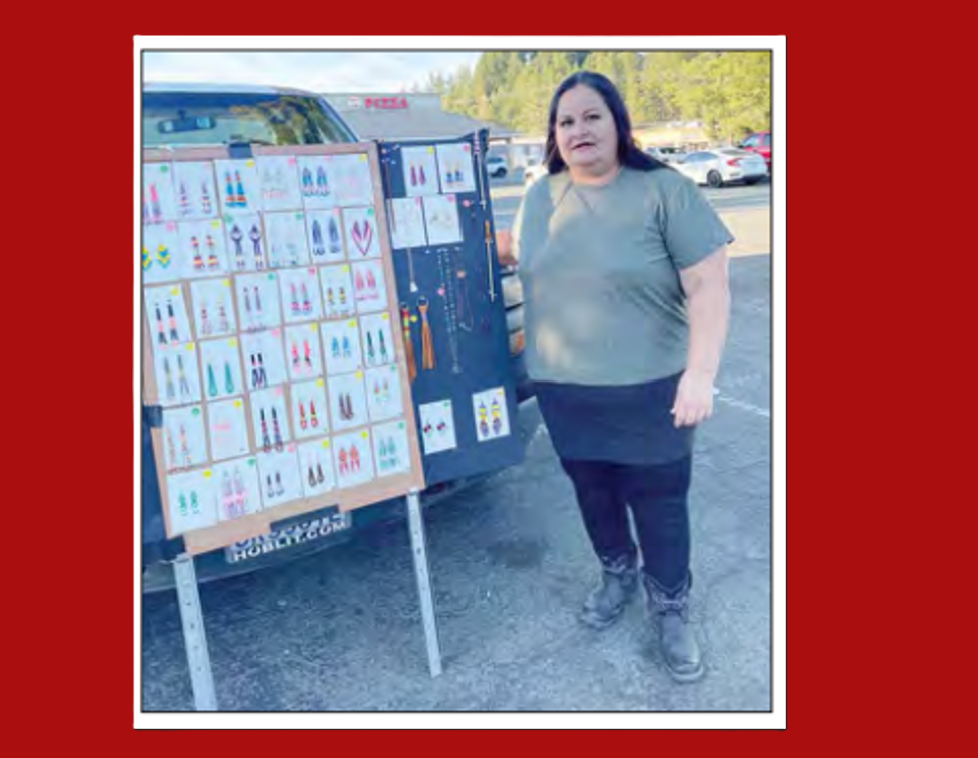
Photo: Chumash Beader Alishaw Enike Brice
Alishaw Enike Brice started beading with her grandmother when she was ten-years old. Now Brice, a mother of five grown children, is determined to share the cultural tradition of beadwork with her grandchildren while also trying to earn a living.
“It’s a legal hustle,” Brice says, as she sells beaded necklaces and earrings from her makeshift store front assembled out of cardboard in front of her truck in a grocery store parking lot. Brice has set up shop under the freeway overpass where there’s ample parking and in the parking lot of a local liquor store with the permission of the owner. “We’ve been harassed by the sheriff, shut down by the permit regulator for selling on Main street even though we had permission from the owner to be there.”
Why doesn’t Brice just get a permit to avoid all the hassle? Because, she says it sounds easier than it is. Last time Brice checked, a permit was $80, but she was required to pay $800 upfront for taxes. At the end of the year, permit holders can keep the balance after their taxes are deducted. “People wonder why people steal?” Brice rhetorically asks. “Well, because we’re not even allowed to stand on the side of the street earning money by selling something legal? They’re making it very hard for the underdog.”
Brice is a member of the Chumash tribe with roots in the San Ynez reservation in Southern California who now resides in Willits. Brice doesn’t have federally recognized paperwork to show her Native ancestry. Instead she carries stories, crafts and a virtual photograph chalk full of images of her grandfather Semu Huate, her mother, her aunties and her own children. Brice’s grandfather, Semu Huate, was a member of the actor’s guild in Ventura County in the early 1900s.
“My grandfather was a rebel and didn’t want an enrollment number or any kind of government assistance,” Brice explains. “Now we’re paying the price.”
Of the seven bands of Chumash tribes, only one is federally recognized and has access to casino funds. Brice’s band is recognized only at the state level. “State recognition doesn’t even give me access to commodities.”
As a mother of five children and now a grandmother of ten, who experienced domestic violence, housing insecurity, chemical dependency and a bout of incarceration before recovery, Brice can’t help wondering how her life might’ve been different if her tribal affiliation was federally recognized, which would’ve given her access to more services.
Jose Arceniaga is the program director of the Office of Child Care working under the CCDF block grant to help connect Native parents who are working or studying with childcare resources. “To enroll, families show proof of tribal affiliation, proof of employment or studies, and then we send paperwork to the care provider and it’s a pretty straightforward process,” Arceniaga says.
When asked about someone in Brice’s situation, who has only photos, stories and her word to offer about her tribal affiliation, Arceniaga sighs.
“I hate to hear (stories like this) because she’s obviously an indigenous native woman trying to do right, but in this system, she kind of slips through the cracks,” Arceniaga says.
Arceniaga says Brice’s situation is more common than folks would like to think, as he yields calls with people in similar situations every month.
“It’s (a product of) the history of Native American people..There was the saying ‘erase the indian, save the man,’ It was a cultural genocide,” Arceniaga says. “There has to be a way to update the system.”
Brice credits the presence of her grandchildren and a woman’s program in Ventura County that she was released to after serving time related to paper crimes related to her drug and alcohol dependency issues. “Going to NA and AA meetings, attending all the parenting classes, the anger management classes and more,” Brice says. “I took every class that was available to me and even if I didn’t use it at the moment, I’ve been able to look back and use those tools today.”
These days Brice leans on resources like the Mending Basket Resource Center in Willits, which she’s called home for the past six years, to stay connected, keep her skills sharp and stay in touch with her native roots as she passes on her culture and traditions to the generations behind her.
“I grew up around Native American intertribal culture and song and dance ceremony,” Brice recalls with a smile. “Now I’m teaching my six-year old granddaughter to do bead work and handing down the tradition of ceremonies to my kids and grandkids. Our language isn’t spoken fluently anymore, so we’re trying to keep on handing down what we know so our traditions won’t be lost.”
Joaquin Esquivel, a program coordinator at the Inter-Tribal Council of California, believes strongly that when women like Brice take the next generation under their wings to show them the Native ways and traditions, intergenerational cycles of violence and struggles can be replaced with something positive. “When we start with children, break the cycles and teach them about native beliefs,” Esquivel says, “we can impact long lasting change.”
Both Esquivel and Arceniaga worry about Trump’s proposed sanitized census data collection for 2030 that would remove questions about race and ethnicity, and stop counting undocumented persons and asylum seekers.
“I feel like Mr. Trump is picking on us. First, he took away Indigenous People’s Day and turned it back to Christopher Columbus Day, and now this,” Esquivel said. “This feels like another way to systematically abandon Indigenous people.”
Esquivel noted that many Native Americans today are mixed race and are impacted by Trump’s policies. “We come in all colors, sizes and shapes and don’t look or act in one stereotypical way.”
Arceniaga worries that the government may simply stop accounting for those living on reservations, which he says would amount to erasure.
“I feel like this goes away with the treaties we agreed to in the first place,” Arceniaga says. “We need a voice. There’s the problem with Missing & Murdered Indigenous women, fentanyl, the list goes on. How can we speak up about the problems (our communities) are going through.”
A-dae Romero-Briones, the Vice President for Policy & Research, California Tribe Fund and Native Agriculture and Food Systems Investments says it’s likely that many Native and Indigenous People living on reservations are already being undercounted.
“Long ago, we had treaties that said in exchange for land, certain services would be offered,” Romero-Briones said. “When census clouds the definitions of both tribal sovereigns, indigenous communities, tribal versus rual–it’s all part of away to minimize the federal responsibility of federal government to tribal governments.”
Above that, Romero-Briones says representation matters. She recalled efforts in previous census collection points to increase the numbers of Native and Indigenous data collectors. “Before that people weren’t opening their doors for people who knocked on doors claiming to be from the federal government,” Romero-Briones. “They got more accurate data that way, but the system is still imperfect. In order to collect data, there has to be a cycle of evaluation that has stopped with the Trump administration.”
Brice, who is part of what could be referred to as the Native Diaspora and lives hundreds of miles from her home reservation and has spent most of her life off-grid, may be disheartened by the conflicting pressures to prove her identity as a Native woman in one context but have it erased when it comes to being counted. So she’ll use the tools she has–her voice to share her story and her Native artistry to string together wearable art, generational traditions and a vision of sustainable income.