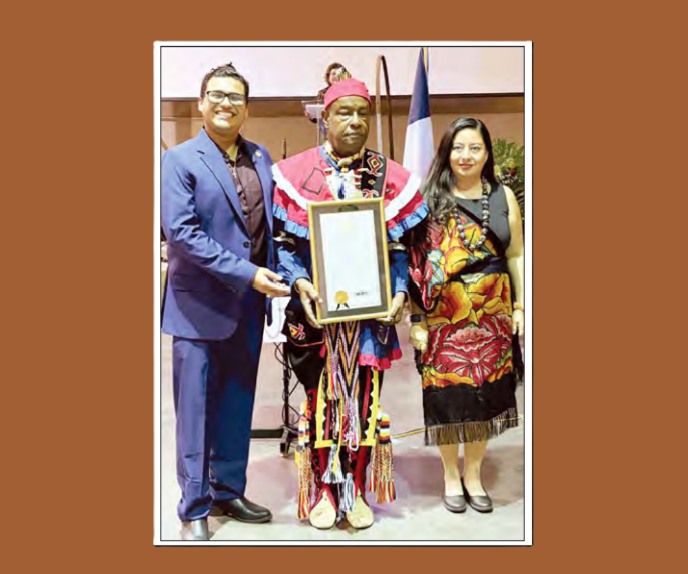
Photo:(On the right) Consul de Mexico Vivian Juarez Mondragon, (on the left) Maverick County Judge Pablo Garcia, Jr.
On Friday, October 30 and Saturday, October 31, an event titled “The Pillars of Our Legacy” was held in Eagle Pass, Texas, at the International Center for Trade. Directed by the Warren Perryman Foundation for Native American Research and presented by the City of Eagle Pass, “The Pillars of Our Legacy” honored the history of the Seminole Negro Indian Scouts, with a particular focus paid to the first twelve men who were mustered into service in 1870.
The twelve men were Pvt. Pompey Factor (age 16), Pvt. Adam Fay (age 18), Pvt. John Ward (age 20), Pvt. George Washington (age 21), Pvt. John Wilson (age 45), Pvt. Hardie Factor (age 60), Pvt. John Thomasson (age 18), Pvt. Joe Dixie (age 19), Pvt. Robert “Bobby” Kibbett (age 20), Pvt. Dindie Factor (age 21), Pvt. John Wood (age 60), and Sergeant John Kibbett (age 60).
These men were Black Seminoles. The ethnogenesis of the Black Seminoles took place when enslaved Africans (also known as maroons) absconding from slavery in the Lowcountry Region of the US encountered the Seminoles, who were mostly Lower Creeks (Muscogees) who were fleeing Georgia and Alabama in what, at that time, was Spanish Florida. These two groups would fight for their freedom in La Florida against the US. Three significant wars known as the Seminole Wars (1816-1858) would be fought. The most significant war for the Black Seminoles was the Second Seminole War (1835-1842). Following that war, the leaders of the Black Seminoles agreed to relocate to Indian Territory (present day Oklahoma), where they believed they would be able to live in peace. Once they arrived in Indian Territory, however, they discovered that they were under constant threat of being stolen into slavery. In 1850, a group of Black Seminoles (led by John Horse) and a group of Seminoles (led by Wild Cat) traveled more than 700 miles to Mexico, which had abolished slavery in 1829. Mexico also needed help protecting its border. The Black Seminoles would serve as the country’s first “border patrol” from 1850 to 1870. After twenty years of service and following the end of the Civil War and the emancipation of enslaved people in Texas, the Black Seminoles agreed to cross the border and join the military as scouts. They crossed the Mexican border back into Texas on July 4, 1870, and were officially mustered into service on August 16 of that same year. The men would be stationed at Fort Duncan from 1870 to 1872. They would move to Fort Clark in Brackettville in 1872 and would remain there until they were unceremoniously disbanded in 1914. During their forty-four years of service, which saw just over 150 men join, not one scout was every seriously injured or killed during battle. Four of these men (including two of the first men who were mustered in John Ward and Pompey Factor, along with Adam Paine/Payne and Isaac Payne) were awarded the Congressional Medal of Honor. These four men are interred at the Seminole Indian Scouts Cemetery in Brackettville, Texas.
Thomi Lee Perryman, who is a Black Seminole who is a descendant of several of these Seminole Negro Indian Scouts and director of the Warren Perryman Foundation for Native American Research, deeply understands the sacrifices that these men and their families made. He has produced several events that honor their legacy. “The Pillars of Our Legacy” is just the latest in a long line that he has crafted to honor, show respect for, and to teach the wider public about this important history. The Seminole Indian Scouts Cemetery Association was honored to collaborate with the Warren Perryman Foundation for Native American Research for this truly special event.
On Friday, October 30, there was a meet and greet that allowed everyone to mingle and enjoy great finger foods ahead of the main event. The next morning, there were a series of lectures that set the tone for the whole day. Lecturers include Frank Garcia, Chief Patton Sims, Bernard Allen Bey, Anastasia Pittman, and Dr. Wallis Tinnie.
That evening, mistress of ceremonies Carmen Guiterrez expertly guided the audience through a program that was filled with honor and reverence. The beautifully decorated space included twelve empty chairs that honored the first scouts. VFW Post 8562 of Eagle Pass, led by vice-commander Miguel Chavez, presented the American flag, and UTNC, which is a Mexican all-female color guard presented Mexican flag. Bailando por Mexico, directed by Adriana Salizar Martinez, and Chief Daniel Eagle Warrior performed. Keynote speaker Rep. Eddie Morals delivered an address that showed his deep interest and passion regarding the Seminole Negro Indian Scouts. The Hon. Pablo Garcia, Jr., Maverick County’s judge, issued a proclamation naming October 31st “Seminole Negro Indian Scouts Day.” To close out the event, a beautiful video was shown that honored the lives of several loved ones who had passed.
An unknown amount of time and hard work went in to producing “The Pillars of Our Legacy.” The reverence and deep respect for the Seminole Negro Indian Scouts was apparent at every moment. These men and their families endured untold hardships, yet they served with honor and distinction. Honoring them any chance that we can is the very least that we can do.