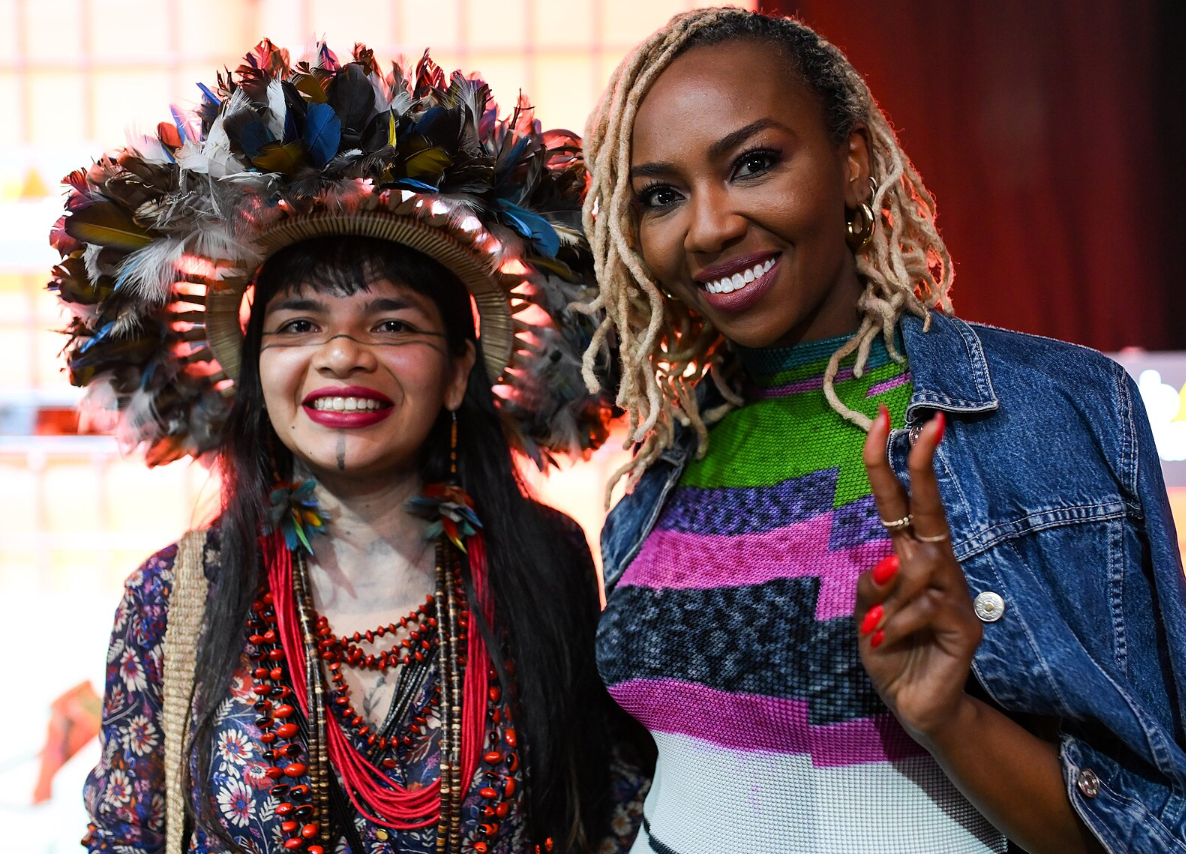
Image: Txai Suruí (of the Y carrying Surui tribe) Amazonian Activist, left, and Ayọ Tometi, Co-founder, Black Lives Matter, during the opening night of Web Summit Rio 2023 at Riocentro in Rio de Janeiro, Brazil. Photo by Stephen McCarthy/Web Summit Rio via Sportsfile, Wikimedia
Ypikuera is a genetic signal that is shared in common with some Indigenous South Americans, the people of Melanesia and even some individuals in the Aleutian Islands of Alaska.
These long machete like knives are called pangas. You rarely see a man without one, they are his tools for all things. Although they may look threatening, they are only used against each other rarely. We were met with kindness everywhere. One local told us that they love tourists only hate each other!Enga Province, Western Highlands, PNG, Wikimedia
Commonly called “the Y signal,” it should not be confused with the Y chromosome that determines biological maleness in humans. This Y signal can be carried by both males and females.
Women in West Papua (Indonesia), part of Melanesia, Wikimedia
The name comes from the Brazilian Tupi word for “ancestor”, Ypikuera. Scientists assert that Melanesians were the first human arrivals to the Americas, and spread their Y signal deep into South America, where it survives in some widely scattered Indigenous populations.
Y appears in a low percentage (such as 2%) even among the communities in which it appears, which is an indicator that it is ancient. It survives mostly in relative isolation, such as among the Suri people of Brazil, though scientists believe it was present in South America until large-scale enslavement during the European invasions.
“The study also reveals that approximately 2% of the genome of some Indigenous American peoples shows genetic affinity with populations from Australasia, such as those in Australia, New Guinea, and the Andaman Islands. This connection—found in South American individuals dating back more than 10,000 years and present in very similar proportions—suggests the influence of an unsampled ancient Asian population, termed "Ypykuéra" (Y-ancestry), which intermixed with the ancestors of these groups.”--Tabita Hünemeier, translated from the Spanish by Google Translate
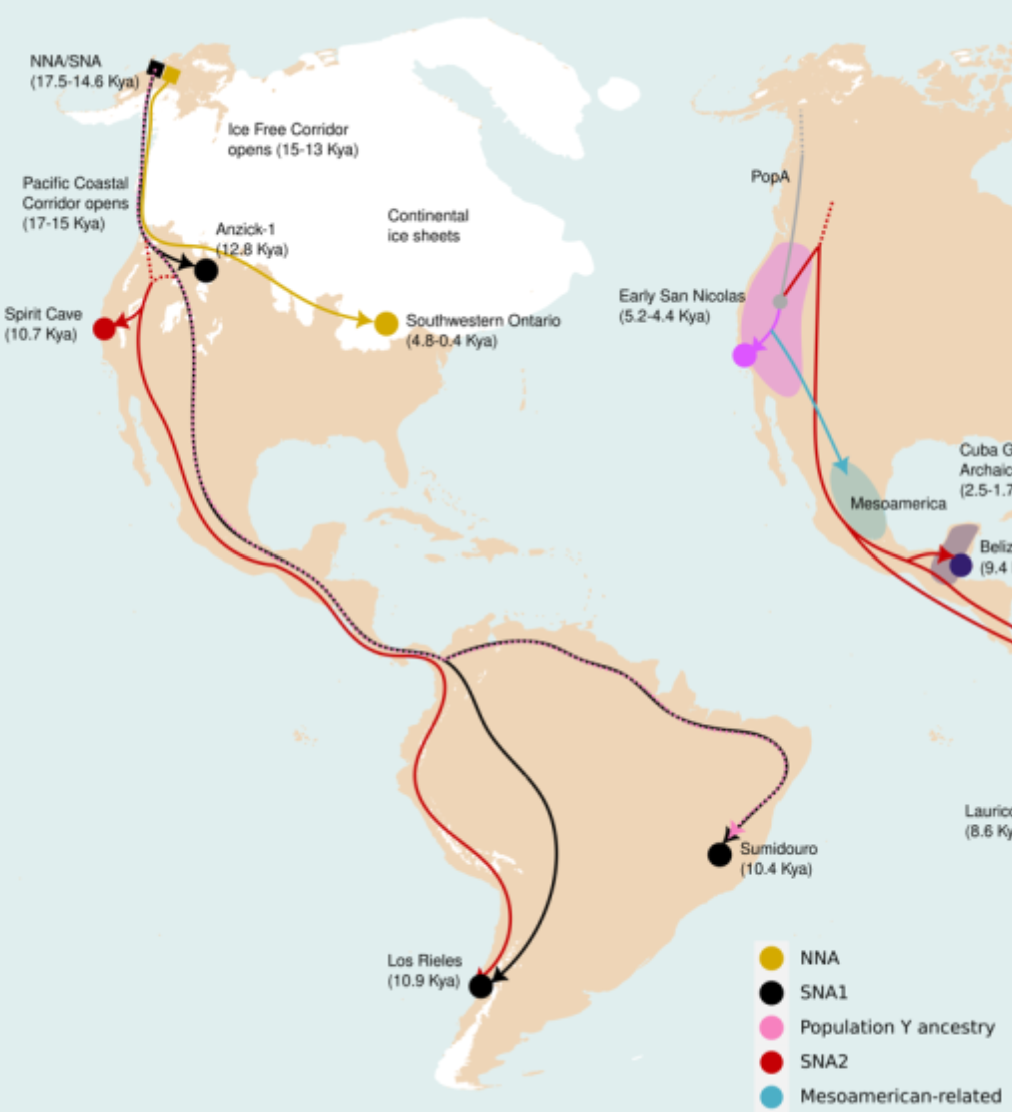
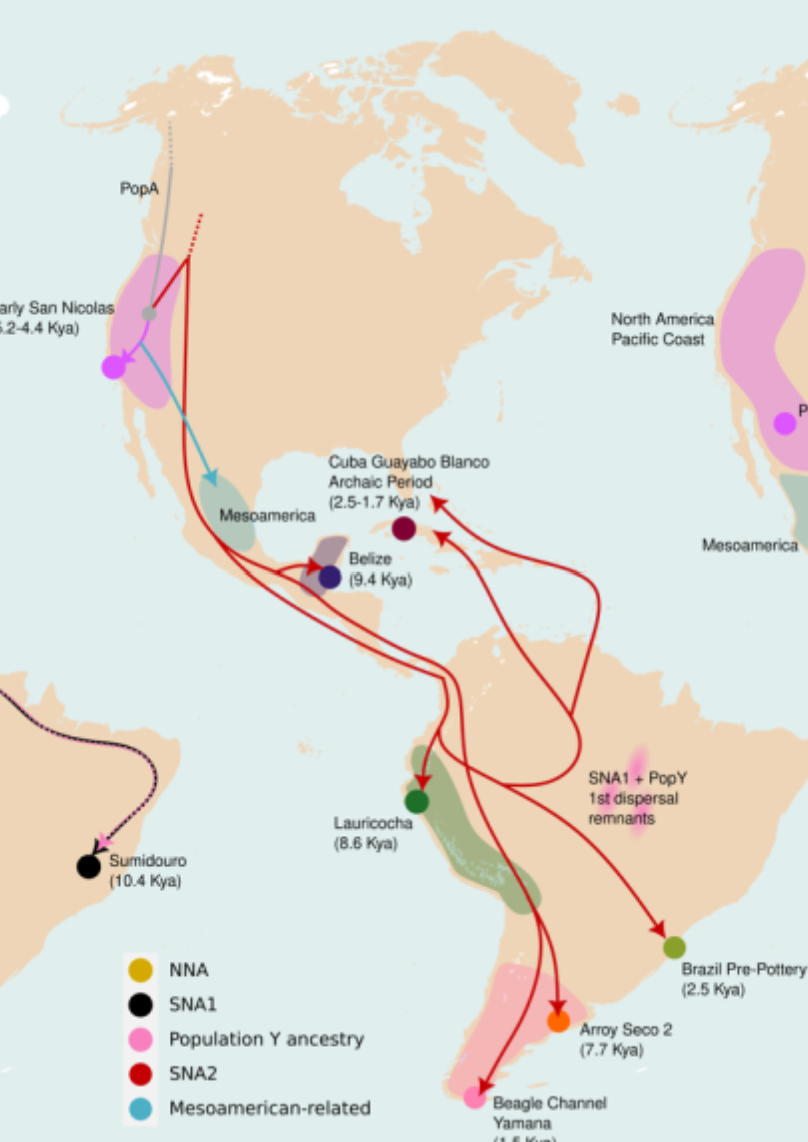
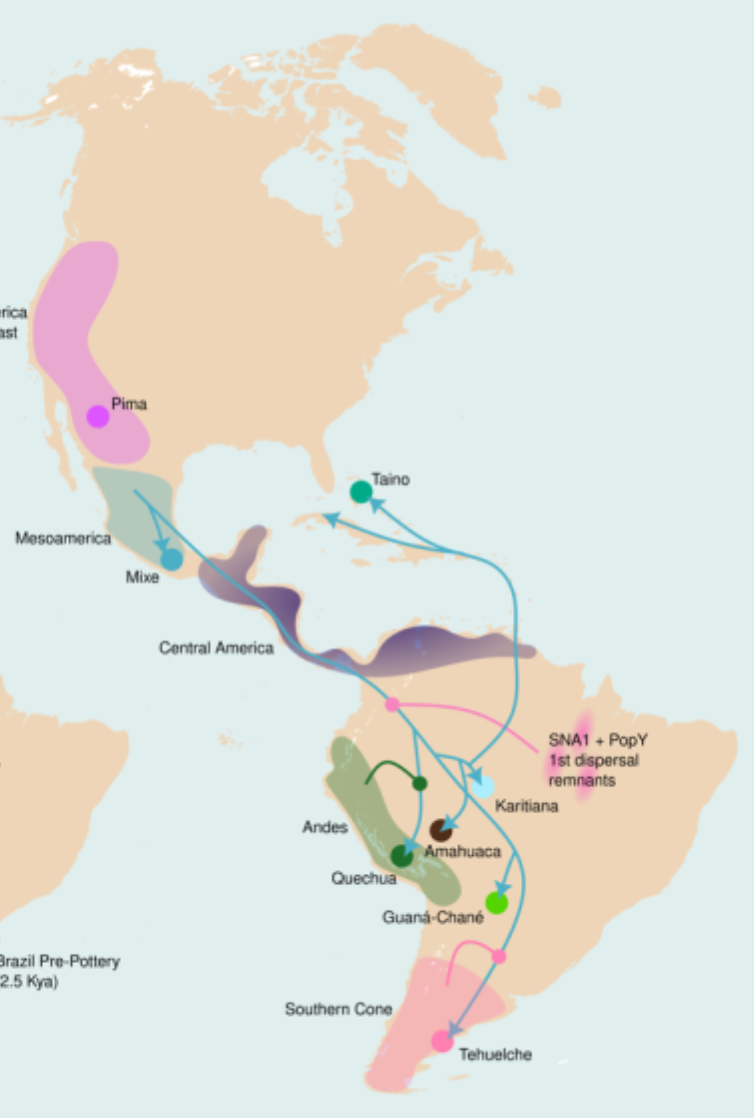
The three maps below show how Ypykuera carriers entered the Americas, and also how they later mixed with east Asian migrants who later moved north into the Caribbean. Indigenous Caribbeans later established contact with the eastern coast of North America, including what became the United States.
(The circles in all three maps indicate the approximate locations of ancient individuals or present-day populations, and the arrows denote the dispersal routes.)
This map shows the first dispersal (>9,000 years ago) and the initial splits among the ancestors of Indigenous Americans: Northern (NNA) and Southern (SNA)—the latter further divided into two branches (SNA1 and SNA2). It also includes the contribution of the hypothetical "Population Y."
This map shows the second dispersal (<9,000 years ago), primarily associated with SNA2, which partially replaced earlier populations, although some groups with an infusion of "Population Y" ancestry persisted. Several regions show genetic continuity spanning thousands of years (shaded areas).
This map shows the third dispersal (<1,300 years ago), associated with Mesoamerican populations, which contributed significantly to South America and the Caribbean. These populations admixed with groups from the first dispersal (including those with "Population Y" ancestry) and—in the Andes and the Southern Cone—primarily with populations from the second dispersal, maintaining genetic continuity in these regions that dates back as far as 9,000 years. Note the northward expansion of the Melanesian (Melanated) descendants into the US Southeast
Sources:
Juan F. Caler, "Tábita Hünemeier, the researcher behind the largest genetic database of Indigenous Americans: “The most important thing is that we are contributing to more equitable medicine," Innovospain.com, April 22, 2026.